Roughly 77 percent of American households carry some form of debt, according to the Federal Reserve’s Survey of Household Economics. The average household debt balance exceeds $100,000 when mortgages are included. For workers earning under $40,000, the standard advice to “throw extra money at debt” ignores the reality that there often is no extra money. This guide covers strategies that work when your margin is thin: tactical payoff methods, creditor negotiation scripts, hardship programs, and medical debt tactics that most guides skip entirely.
For broader context on rebuilding your financial foundation, see our pillar guide on building credit from scratch.
Debt avalanche vs. snowball: which actually saves more money?
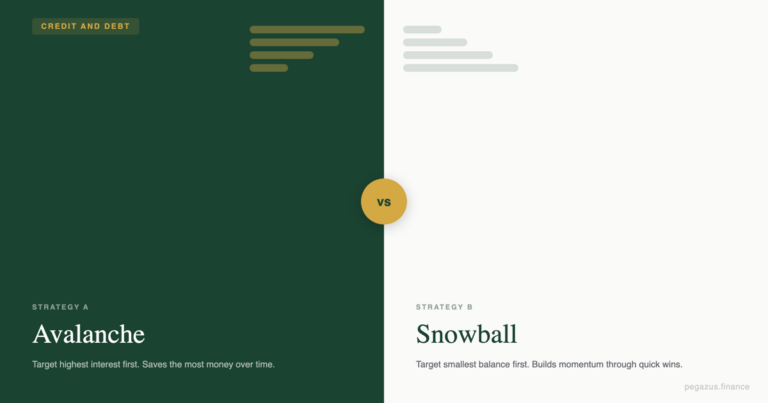
The avalanche method targets the highest-interest debt first, saving the most money over time. The snowball method targets the smallest balance first, generating psychological wins faster. For low-income earners, the avalanche method is the better choice because every dollar of interest saved matters more when your budget has no slack.
| Debt | Balance | Interest Rate | Min Payment | Avalanche Order | Snowball Order |
|---|---|---|---|---|---|
| Credit Card A | $4,200 | 24.99% | $105 | 1st | 3rd |
| Credit Card B | $1,800 | 19.99% | $54 | 2nd | 2nd |
| Medical Bill | $950 | 0% | $50 | 4th | 1st |
| Personal Loan | $6,500 | 11.5% | $150 | 3rd | 4th |
With $100 extra per month above minimums, the avalanche method pays off this debt 3 months faster and saves approximately $1,340 in total interest compared to the snowball method. That difference grows larger with higher-rate debt. The CFPB recommends keeping total debt-to-income below 43 percent, and the avalanche method reaches that threshold faster.
How do you negotiate directly with creditors?
Creditors would rather collect a reduced amount than send your account to collections, where they recover roughly 20 cents on the dollar. This gives you leverage. Call the creditor’s hardship department directly, not the general customer service line.
Three negotiation paths that work:
- Hardship program. Most major credit card issuers (Chase, Capital One, Discover, Citi) offer hardship programs that reduce your interest rate to 0-9 percent for 6 to 12 months. You must ask. They do not advertise these programs. Say: “I am experiencing financial hardship and would like to discuss options for reducing my interest rate or monthly payment.”
- Lump-sum settlement. If you have access to a one-time sum (tax refund, gift, side income), offer 40 to 60 percent of the balance as a settlement. Get the agreement in writing before sending payment.
- Payment plan restructuring. Ask for a lower minimum payment spread over a longer term. This frees cash flow for the avalanche method on your highest-rate debt.
What hardship programs exist for low-income earners?
Federal and nonprofit programs provide real relief, but most people do not know they exist or how to qualify.
Student loans: Federal student loan borrowers earning under $32,805 annually (150 percent of the federal poverty level for a single person) qualify for $0 monthly payments under the SAVE plan. The Department of Education reports that income-driven repayment plans cover over 11 million borrowers. Private student loans do not qualify, but many private lenders offer forbearance or rate reduction programs if you call and ask.
Medical debt: Nonprofit hospitals are required under Section 501(r) of the Internal Revenue Code to offer financial assistance programs, commonly called charity care. If your income falls below 200 percent of the federal poverty level ($30,120 for a single person in 2026), many hospitals will write off the entire bill. You must apply in writing. The Centers for Medicare and Medicaid Services tracks hospital charity care obligations. Start by calling the hospital billing department and asking for the financial assistance application.
For a related look at what happens to your credit score during debt payoff, see our article on why your credit score drops after paying off debt.
Should you use a balance transfer card to pay off debt faster?
A 0 percent APR balance transfer card can save hundreds in interest if you qualify. The best cards offer 15 to 21 months at 0 percent with a 3 to 5 percent transfer fee. On a $4,000 balance at 24.99 percent APR, transferring to a 0 percent card with a 3 percent fee ($120) saves $1,000 or more in interest over 15 months.
The catch: you need a credit score of 670 or higher to qualify for most balance transfer offers. If your score is below that, the hardship program route is more realistic. And the transfer only helps if you stop adding new charges to the original card. Cutting the card or freezing it removes the temptation.
What are the practical first steps if you earn under $40,000?
When your annual income is under $40,000, the margin for debt payments is razor thin. The strategy shifts from “pay more” to “pay smarter.”
- List every debt with balance, rate, and minimum payment. Total the minimums.
- Call every creditor and request a hardship rate reduction. Even dropping from 24.99 to 12 percent cuts interest in half.
- Apply for charity care on any medical debt. Hospital billing departments process these applications regularly.
- Enroll in income-driven repayment for federal student loans. This may drop your payment to $0.
- Find $50-100 per month above minimums. Cancel subscriptions, switch phone plans, negotiate insurance rates. Direct that amount to the highest-rate debt exclusively.
- Apply one-time windfalls (tax refund, stimulus, gifts) directly to debt. A $2,000 tax refund on a $4,200 credit card balance at 24.99 percent saves over $500 in interest.
The math is straightforward. If your total minimum payments consume your entire discretionary income, the hardship and charity care routes must come first. Reduce the burden, then apply the avalanche. Trying to power through with sheer extra payments on a $35,000 salary with $13,000 in debt is a recipe for burnout.
For the broader framework of managing money at any income level, see our budgeting guide for beginners. Our research methodology page explains how we verify the programs and rates cited in this guide.
Frequently Asked Questions
Sources