The safest way to earn interest on savings is a high-yield savings account insured by the FDIC, currently paying 4.50% to 5.00% APY with no lock-up period. For money you will not need for six months or longer, certificates of deposit and Treasury bills offer slightly higher yields with government backing. This guide compares every low-risk option with real rates, risks, and the right use case for each.
What is the safest place to earn interest on cash?
A high-yield savings account at an FDIC-insured bank or an NCUA-insured credit union is the safest interest-bearing option. The Federal Deposit Insurance Corporation guarantees deposits up to $250,000 per depositor, per institution, per ownership category. Your principal cannot lose value, and you can withdraw at any time without penalty.
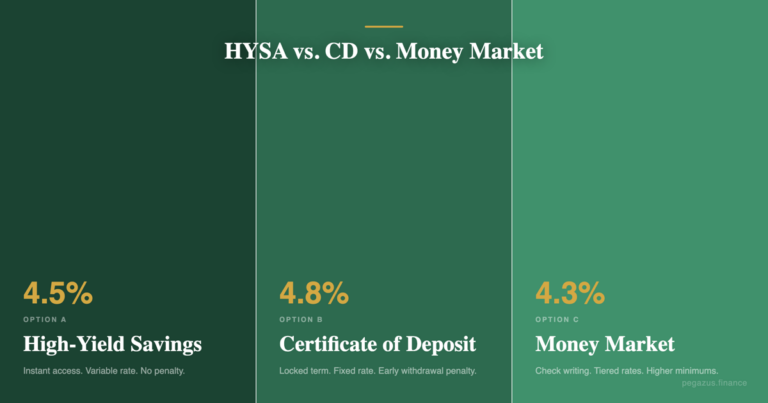
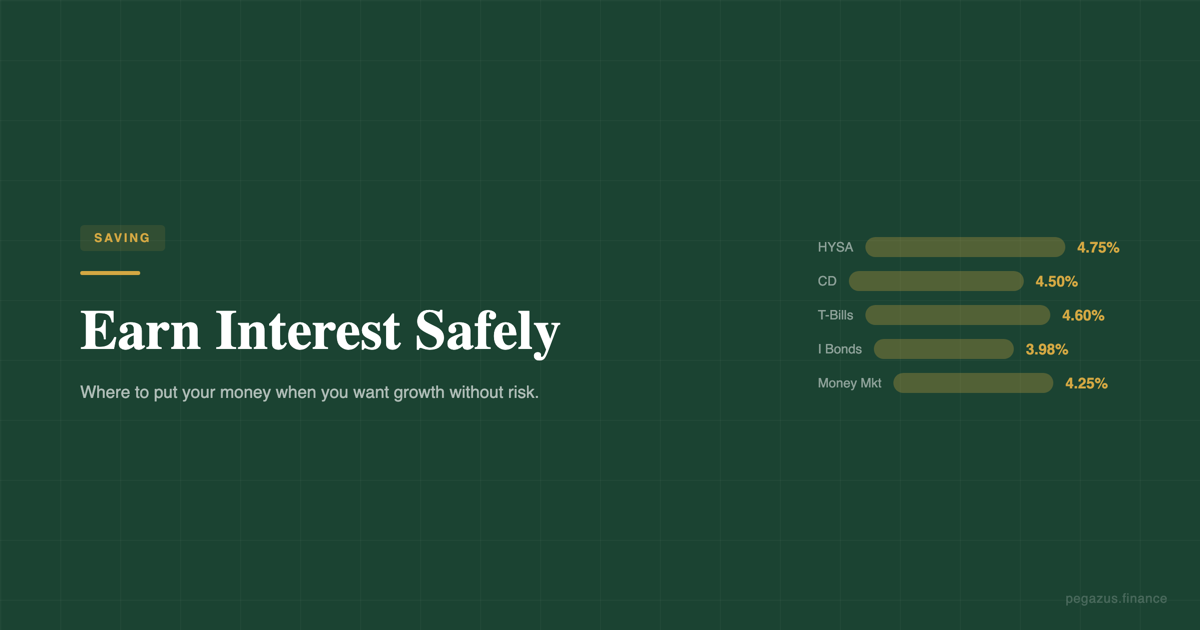
When I last checked, the top high-yield savings accounts offered between 4.50% and 5.00% APY. That rate floats with the federal funds rate, so it changes when the Federal Reserve adjusts policy. On a $10,000 balance, 4.75% APY earns roughly $475 per year. Online banks consistently pay 8 to 12 times more than the national average savings rate of 0.45% APY reported by the FDIC’s national rate survey. The tradeoff is minimal: most online banks have no physical branches, but they offer mobile check deposit, ACH transfers, and customer support by phone.
How do CDs compare to savings accounts?
Certificates of deposit lock your money for a fixed term (typically 3 months to 5 years) in exchange for a guaranteed interest rate. When I last checked, a 1-year CD at a competitive online bank paid between 4.25% and 4.75% APY. The advantage is rate certainty: your rate will not drop even if the Fed cuts. The disadvantage is the early withdrawal penalty, which typically costs 3 to 6 months of interest depending on the institution and term length.
CDs make sense for money you know you will not need until a specific date. A sinking fund for a vacation in 12 months is a natural fit. An emergency fund is not, because you may need it at any time. A CD ladder, where you split your savings across staggered maturity dates, gives you both rate protection and periodic liquidity. For example, dividing $12,000 across four CDs maturing every 3 months ensures one CD matures every quarter while the rest earn the locked rate.
Are Treasury bills and bonds better than bank accounts?
Treasury securities are backed by the full faith and credit of the U.S. government, making them the lowest-risk investment that exists. Treasury bills (T-bills) mature in 4 to 52 weeks. You buy them at a discount through TreasuryDirect.gov and receive the full face value at maturity. When I last checked, 26-week T-bills yielded around 4.50% to 4.75%.
The tax advantage is significant. Treasury interest is exempt from state and local income taxes. For someone in a state with a 5-9% income tax rate (California, New York, New Jersey), a Treasury yielding 4.50% is equivalent to a bank account paying roughly 4.90% before state taxes. Series I Bonds offer inflation protection: the rate combines a fixed component with a variable rate tied to CPI. The annual purchase limit is $10,000 per person through TreasuryDirect, and you must hold them for at least one year. Redeeming before five years forfeits the last three months of interest.
What about money market accounts and funds?
Money market accounts (MMAs) are bank products insured by the FDIC, similar to savings accounts but often with check-writing and debit card access. When I last checked, competitive MMAs paid 4.00% to 4.50% APY. The full comparison of HYSAs, CDs, and money markets breaks down the rate differences in detail.
Money market funds are different. They are mutual funds offered by brokerages like Vanguard, Fidelity, and Schwab. They invest in short-term government securities and commercial paper. They are not FDIC-insured, but government money market funds (which hold only Treasuries and government-backed securities) have effectively zero credit risk. Fidelity’s Government Money Market Fund (SPAXX) and Vanguard’s Federal Money Market Fund (VMFXX) are the two largest. These funds sometimes yield slightly more than bank HYSAs and are convenient if your cash already sits in a brokerage account.
Which option earns the most interest right now?
The answer depends on your time horizon and liquidity needs. Here is how every major low-risk option compares:
| Account type | Typical APY | FDIC/Gov backed | Liquidity | Best for |
|---|---|---|---|---|
| High-yield savings | 4.50-5.00% | Yes (FDIC) | Immediate | Emergency fund, short-term goals |
| Money market account | 4.00-4.50% | Yes (FDIC) | Immediate + checks | Operating cash that needs check access |
| 1-year CD | 4.25-4.75% | Yes (FDIC) | Locked (penalty) | Known expenses 6-12 months out |
| Treasury bills (26-week) | 4.50-4.75% | Yes (US Gov) | Locked until maturity | State-tax-free yield, 6-month horizon |
| Series I Bonds | Variable (inflation) | Yes (US Gov) | 1-year minimum hold | Long-term inflation hedge, $10k/yr limit |
| Gov money market fund | 4.50-5.00% | No (but Gov securities) | Next business day | Brokerage cash sweep |
My recommendation: keep your emergency fund in a high-yield savings account for instant access. Put any savings beyond that target into Treasury bills or a CD ladder, depending on whether the state tax benefit matters in your situation. The rate difference between options is small. The bigger mistake is leaving cash in a checking account earning 0.01%.
How much can you realistically earn on $10,000?
On $10,000 in a high-yield savings account at 4.75% APY, you earn approximately $475 in the first year through compound interest. That same $10,000 in a typical checking account at 0.01% APY earns $1. The difference is $474 per year in free money for moving your cash to a different account at the same level of safety.
Compounding amplifies the gap over time. After 5 years at 4.75% APY with no additional deposits, $10,000 grows to roughly $12,610. With $200 in monthly additions, it reaches approximately $25,900. The SEC’s compound interest calculator lets you model your exact scenario. The point is not that savings accounts make you rich. They do not. The point is that parking cash at near-zero rates has a real cost measured in hundreds or thousands of dollars per year.
Frequently Asked Questions
Is my money safe in an online bank?
Yes, as long as the bank is FDIC-insured. Online banks like Ally, Marcus by Goldman Sachs, and Capital One 360 carry the same FDIC insurance as traditional banks. Verify FDIC membership at BankFind before opening an account. Your deposits are protected up to $250,000.
Do I pay taxes on savings account interest?
Yes. Interest earned in savings accounts, CDs, and money market accounts is taxed as ordinary income. Your bank will send a 1099-INT form if you earn more than $10 in interest during the year. Treasury securities are exempt from state and local taxes but still subject to federal income tax.
Can savings account rates go down?
High-yield savings account rates are variable and move with the federal funds rate. When the Federal Reserve cuts rates, HYSA yields typically follow within weeks. If locking in a rate matters, a CD guarantees your rate for the full term regardless of future Fed decisions.
Should I keep all my savings in one bank?
FDIC insurance covers $250,000 per depositor per institution. If your total savings exceed that amount, spread it across multiple FDIC-insured banks. For most people with under $250,000 in cash savings, a single high-yield savings account is simple and fully protected.