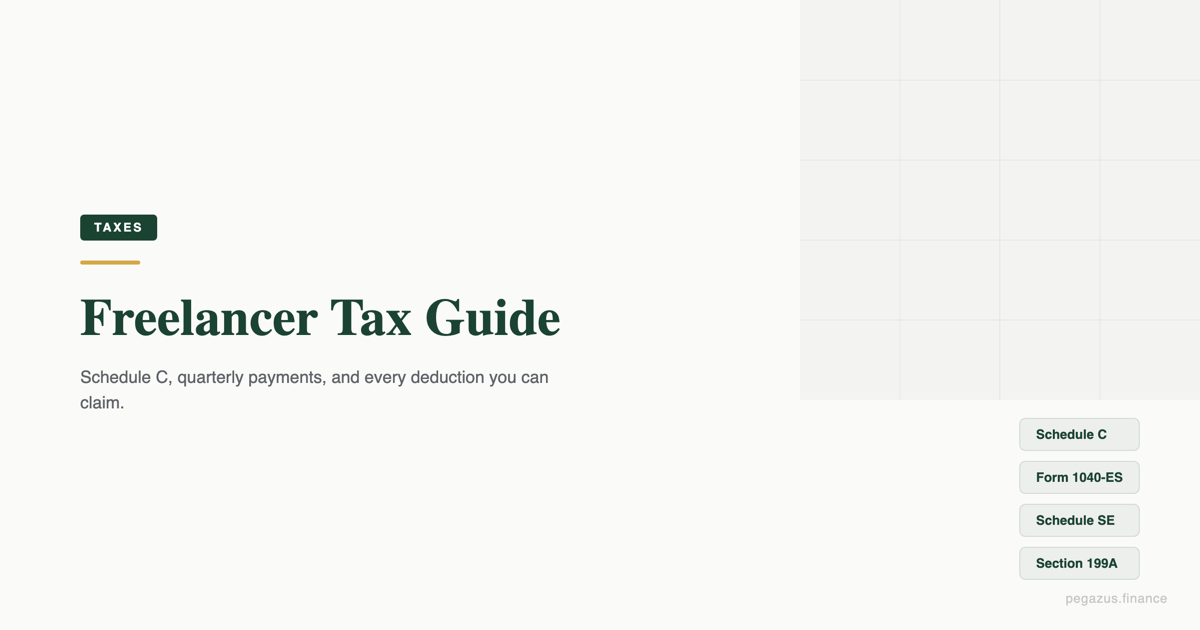
How to File Taxes as a Freelancer for the First Time
Nathan Cross||6 min read|Last reviewed September 1, 2026
Filing taxes as a freelancer requires Schedule C for business income, Schedule SE for the 15.3% self-employment tax, and Form 1040-ES for quarterly estimated payments. You will owe both income tax and self-employment tax on your net profit. The IRS penalizes underpayment of $1,000 or more at filing, so paying quarterly is not optional once your income is steady.
What forms do freelancers need to file?
Freelancers file four core forms with the IRS: Schedule C to report business profit or loss, Schedule SE to calculate self-employment tax, Form 1040-ES for quarterly estimated payments, and the standard Form 1040 as your annual return. These forms work together to report both your income tax and your self-employment tax obligations.
Schedule C is where you subtract business expenses from gross revenue to find your net profit. The IRS requires this form for any sole proprietor or single-member LLC. If you received $600 or more from a single client, that client should have sent you a 1099-NEC, but you owe taxes on all income whether or not you received a 1099. Schedule SE applies the 15.3% self-employment tax rate to 92.35% of your net earnings from Schedule C. This covers Social Security at 12.4% and Medicare at 2.9%, both the employee and employer portions.
Form
Purpose
When to file
Schedule C
Report business income and expenses
With annual 1040
Schedule SE
Calculate self-employment tax (15.3%)
With annual 1040
Form 1040-ES
Pay quarterly estimated taxes
Apr 15, Jun 16, Sep 15, Jan 15
Form 1040
Annual individual income tax return
Apr 15 annually
1099-NEC
Income statement from each client ($600+)
Received by Jan 31
How much tax do freelancers actually owe?
Freelancers pay two separate taxes on net profit: federal income tax at their marginal rate and self-employment tax at 15.3%. Combined, most freelancers earning between $50,000 and $100,000 in net profit pay an effective total rate between 25% and 35% before deductions. Setting aside 25% to 30% of each payment covers most situations.
The self-employment tax alone is 15.3% on the first $168,600 of net earnings (when I last checked), covering 12.4% for Social Security and 2.9% for Medicare. Above that threshold, you still pay the 2.9% Medicare portion. An additional 0.9% Medicare surtax applies to earnings above $200,000 for single filers. The IRS lets you deduct half of your self-employment tax from your adjusted gross income, which reduces your income tax. This deduction appears on Schedule 1 of Form 1040. For someone earning $60,000 in freelance net profit, the SE tax is roughly $8,478, and the deductible half ($4,239) lowers the income tax base.
When are quarterly estimated tax payments due?
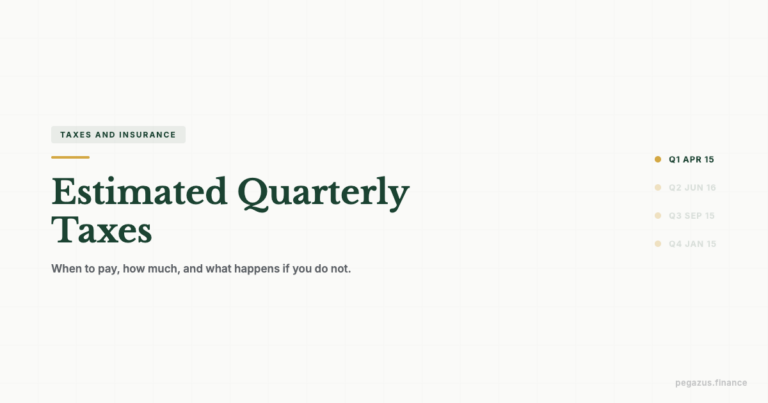
The IRS requires quarterly estimated payments on four fixed dates each year: April 15, June 16, September 15, and January 15 of the following year. You owe a penalty if you underpay by $1,000 or more when you file your annual return. The safe harbor rule lets you avoid penalties by paying at least 100% of your prior year’s total tax liability (110% if your AGI exceeded $150,000).
Use Form 1040-ES from the IRS to calculate each quarterly payment. The simplest approach is to estimate your annual tax, divide by four, and pay that amount each quarter. You can pay through IRS Direct Pay, the Electronic Federal Tax Payment System (EFTPS), or by mailing a check with the 1040-ES payment voucher. EFTPS is the best option for recurring payments because you can schedule them in advance. Missing a quarterly payment does not trigger an immediate penalty. The IRS calculates the underpayment penalty at filing based on how much you owed and how late each payment was.
What deductions can freelancers claim?
Freelancers can deduct ordinary and necessary business expenses on Schedule C, including the home office deduction, health insurance premiums, software and equipment, internet and phone costs (business percentage), professional development, and vehicle expenses for business travel. The Section 199A QBI deduction reduces taxable income by up to 20% of qualified business income.
The home office deduction has two methods. The simplified method allows $5 per square foot of dedicated workspace, up to 300 square feet, for a maximum $1,500 deduction. The regular method requires tracking actual expenses (rent, utilities, insurance) and calculating the percentage of your home used exclusively for business. According to IRS Publication 587, the space must be your principal place of business and used regularly and exclusively for work. The QBI deduction under Section 199A lets most freelancers earning under $191,950 (single) deduct 20% of net profit from their taxable income, separate from Schedule C deductions. Health insurance premiums are deductible on Schedule 1 if you are not eligible for employer-sponsored coverage through a spouse.
Can you file freelance taxes for free?
The IRS Free File program offers free federal filing for taxpayers with adjusted gross income under $84,000 (when I last checked). Several commercial providers participate, including TaxAct and TaxSlayer, through the IRS Free File portal. Free File Fillable Forms are available to any income level but offer no guidance.
Most freelancers with straightforward businesses (no inventory, no employees, fewer than five 1099s) can file using any consumer tax software. The complexity comes from properly categorizing deductions on Schedule C, not from the filing itself. If your annual freelance revenue exceeds $100,000, or you have multiple business entities, hiring a CPA or enrolled agent is worth the $300 to $800 cost. A tax professional who specializes in budgeting and money management for self-employed workers can often find deductions that offset their fee. For your first year freelancing, I recommend using tax software with guided interview mode to learn which categories apply to your situation, then deciding whether professional help is worth it for subsequent years.
What mistakes do first-time freelance filers make?
The most common mistake is not paying quarterly estimated taxes and facing a penalty at filing. Other frequent errors include mixing personal and business expenses, forgetting to track mileage in real time, not deducting the employer-equivalent half of self-employment tax, and reporting gross revenue without subtracting legitimate expenses. These mistakes consistently increase tax bills by $1,000 to $3,000.
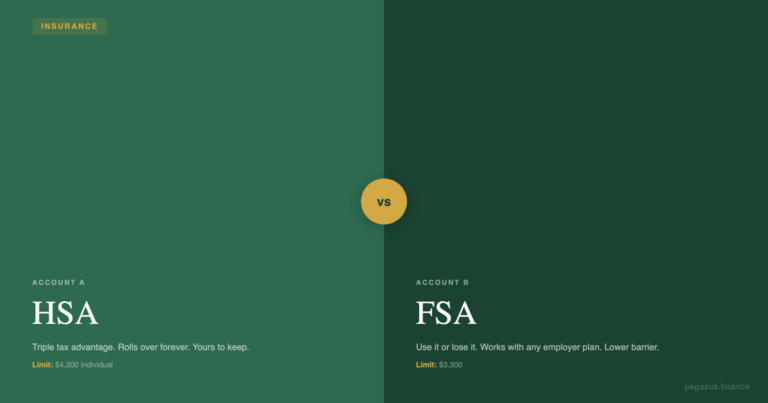
Open a separate business checking account before you earn your first freelance dollar. Run all business income and expenses through this account. This creates a clean paper trail and makes Schedule C reporting straightforward. Track mileage using a dedicated app like MileIQ or Everlance, because the IRS requires contemporaneous records for vehicle deductions. Save every receipt digitally. The challenge of budgeting with irregular income compounds when you also owe taxes quarterly on income that arrives unpredictably. Setting aside 30% of each payment into a dedicated tax savings account prevents the January scramble. Also compare your situation with an HSA or FSA if you purchase your own health insurance, since the premium deduction and account contributions both reduce your tax bill.
Frequently Asked Questions
Do I need to file taxes if I made less than $400 freelancing?
No. The IRS requires you to file Schedule SE and pay self-employment tax only if your net earnings from self-employment reach $400 or more. Below that threshold, you may still need to report the income on your 1040, but you will not owe self-employment tax.
Can I deduct my home office if I also work a W-2 job?
Yes, but only for the freelance portion of your work. The Tax Cuts and Jobs Act eliminated the home office deduction for W-2 employees, but it remains available for self-employment income reported on Schedule C. The space must be used exclusively for your freelance business.
What happens if I miss a quarterly estimated payment?
The IRS charges an underpayment penalty calculated on the amount owed and the number of days late. The penalty rate tracks the federal short-term rate plus 3 percentage points. You can still make a late payment to reduce the penalty amount. The penalty is calculated at filing on Form 2210.
Should I form an LLC for tax purposes?
A single-member LLC is a disregarded entity for federal tax purposes, meaning you file the same Schedule C as a sole proprietor. An LLC provides liability protection but no inherent tax benefit. An S-corp election can reduce self-employment tax if your net profit consistently exceeds $50,000, but it adds payroll obligations.
Nathan Cross is a personal finance writer and certified financial educator based in Denver, Colorado. With eight years of experience covering budgeting, investing, credit building, and debt management, he has helped thousands of readers make smarter money decisions. Nathan reviews every guide against primary sources including IRS publications, SEC filings, and CFPB resources, and updates content quarterly to reflect rate changes and policy shifts. Before writing about finance full-time, he worked as a financial planning associate at a registered investment advisory firm.
A monthly budget works best when fun has its own line instead of hiding inside groceries or bills. Readers who set aside a small, fixed amount for games sometimes spend that slot on casual reels at LuckyLand Slots and stop once the line is used up.
Reading the fine print on a credit card offer is a habit worth keeping everywhere. The same careful eye helps when looking over coin packages and daily rewards at Crown Coins Casino, so nothing surprises you after the purchase clears.
Sinking funds let you save ahead for planned costs like holidays, gifts and hobbies. Some readers keep a modest hobby fund for social games and draw from it when they want a session at Crown Coins, never from their emergency savings.
Before opening any new account, it helps to know how money moves in and out, what fees apply and how long transfers take. Players who budget carefully often review the banking page at Ignition Casino with that same checklist in hand.
Spending limits are one of the simplest tools in personal finance, and they work for leisure as well as shopping. Anyone who plays cards or slots at Ignition can set a session cap in advance and treat it as a firm ceiling.
Sports fans who track their spending tend to plan game day costs the way they plan a night out. If a small wager is part of the fun, keeping it inside the entertainment budget before visiting DraftKings keeps the rest of the month on track.
Free entertainment is a quiet win for any household budget. Readers trimming discretionary costs sometimes pick no purchase play instead, collecting free coins at Chumba Casino while keeping their savings goals untouched.
Cutting back on spending does not have to mean cutting out fun with friends. Social game rooms such as Vegas World let people chat, trade gifts and play casino style games together without adding a new monthly expense.
Trying something for free before paying is a sound rule for subscriptions, apps and hobbies. In that spirit, Vegas World free slots offers reels and bonus rounds with no deposit, so curiosity costs nothing at all.
A frugal evening at home can still feel like a treat. For readers who want a light distraction that does not touch the budget, Casino World free slots has a library of free reels that asks for no payment details.
Comparison shopping is a core money skill, whether you are choosing a bank, a phone plan or a leisure activity. People who weigh options carefully often look at game variety and payout policies at NeoSpin Casino against similar sites.
Knowing exactly which payment methods a service accepts can save time and avoid surprise charges. Readers who keep tidy accounts tend to check the deposit options at Yabby Casino before deciding whether it suits them.
Small, planned pleasures make a tight budget easier to stick with over the long run. A capped session of social sweepstakes games at Yay Casino is one way some readers fit lighthearted fun into a careful spending plan.
Treating play as an entertainment expense, like concert tickets or streaming, keeps expectations realistic. Sports fans who view it that way often decide on a fixed amount first and only then look at the options at BetUS.
Checking that a financial company is licensed and regulated is basic consumer protection. Careful readers apply the same test to gaming brands, and Betway is a recognized name they may look at in states where it is permitted.
Choosing established, regulated providers is a sensible default in banking, and many people bring that preference to leisure too. Well known names like BetMGM appeal to readers who value clear rules and state oversight.
Understanding risk is part of any money conversation, and games of chance are pure risk with no expected return. Exploring how slot variance feels in a free setting at Casino World can make that lesson concrete without spending anything.
Daily rewards are designed to build a habit, which is worth noticing whenever you review your spending patterns. Readers who enjoy the login bonuses at Lavish Luck Casino can still keep any purchases inside a set leisure budget.
Learning a skill before putting money behind it is good practice in almost every area of life. Players who want to understand poker without any cost can practise hand reading and table play at Replay Poker.
A cheap way to unwind after paying the bills can help keep impulse spending in check. For some readers, a short free play session at Chumba fills that role better than an unplanned online shopping trip.
When the entertainment line of your budget is already spent for the month, free options become the obvious choice. Free chips at DoubleDown Casino let people enjoy the sound of spinning reels with nothing more to pay.
New services deserve the same scrutiny as a new bank account: read the terms, check the fees and start small. Readers curious about newer sweepstakes sites often apply that approach when they look at Zula Casino.
Keeping all leisure spending visible in one place makes it easier to see where the month went. Players who use a single account at DraftKings Casino in legal states can review their activity alongside the rest of their budget.
Knowing the difference between free play currency and anything that can be redeemed is like knowing the terms on a rewards card. Readers who learn how coins work at Pulsz Casino can make clear choices about whether to buy anything at all.
Not every break needs a price tag, and simple games with no learning curve make an easy pause between chores. Readers looking for a low effort way to relax sometimes open a quick session at Zone Casino.
Every account you open adds one more statement to track, so it pays to understand the terms first. Sports fans comparing sportsbooks often read the deposit and withdrawal rules at MyBookie before deciding whether it fits their plans.
Bright colours and quick rounds make for easy entertainment, but the budget still sets the rules. Readers who enjoy LuckyLand tend to decide on their limit beforehand and log off when they reach it.
Readers who live or travel abroad quickly learn that rules and protections vary by country, from banking to leisure. Anyone looking at an international sportsbook such as bwin should confirm it is permitted where they are.
Deciding on a cap before you start is the same discipline that keeps a grocery trip under budget. Setting that number ahead of time, and sticking to it, applies just as well to a session at Betway Casino.
Small free perks can stretch a tight entertainment budget a little further. Daily coin bonuses at LuckyLand Casino give casual players something to enjoy without reaching for a card, which suits anyone in a saving phase.
Fans who follow live scores closely can get swept up in the moment, which is exactly when spending rules matter most. Setting a fixed game day amount before opening DraftKings Sportsbook helps keep excitement from overriding the plan.
Protecting your accounts starts with always using the correct login page and a strong password, whether you bank online or play online. That basic habit applies when signing in to Crown Coins as well.
People who organise their money well usually know every way funds leave their account. Before using any gaming site, comparing payment options and limits at BetUS Casino is part of keeping that picture complete.
Fun branding and frequent promotions are built to catch attention, so a clear spending rule helps. Readers who enjoy the colourful games at McLuck can keep things relaxed by deciding in advance what, if anything, they will spend.
A healthy dose of scepticism toward big promises protects your wallet in every corner of life. That same caution is useful when reading coin package terms and promotional conditions at WOW Vegas.
Paying attention to who actually makes a product is part of being an informed consumer. Readers who like to know the source of their entertainment may find it interesting that High 5 Casino develops many of its own slot titles.
Leisure spending is easier to manage when it never mixes with savings or bill money. Readers who try social sweepstakes play at Stake.us often keep a separate small allowance just for it.
Free ways to engage with a favourite team can save real money over a long season. Fans who want to make predictions without paying anything sometimes try the free play format at Sportzino.
Despite the name, no game builds a fortune, and keeping that in mind is part of financial literacy. Readers who enjoy Fortune Coins treat it as a pastime, collecting daily coins for fun rather than expecting anything back.
Friendly competition can make a hobby more enjoyable without making it more expensive. Tournaments and leaderboards at Funrize give casual players a sense of community while they stay within their usual leisure limits.
Starting small and testing first is good advice for any new service. Readers who want to see how a platform works before spending anything can begin with the free coins on offer at Modo Casino.
The word spree is a useful reminder of what a budget is meant to prevent. Anyone browsing the newer lobby at Spree Casino can keep things measured by choosing a time limit and a spending limit first.
Combining two hobbies in one account can make it simpler to track what you spend on both. Fans who enjoy sports picks and casino style games may compare the sweepstakes setup at Legendz Casino with similar options.
Before signing up anywhere, it is worth checking whether the service is legal in your area and what protections apply. Readers researching long running brands such as Bovada should start with those two questions.
Swapping a costly night out for a quiet evening in is a classic way to stay under budget. For some, a short and capped slot session at Cafe Casino is part of that relaxed evening at home.
Understanding every payment method you use, along with its fees and processing times, keeps your monthly statements free of surprises. Readers often review the banking section at Wild Casino with that goal in mind.
Slot outcomes are random and every spin carries a cost, which is why they belong in the fun column and nowhere else. Readers who browse the reel library at Slots.lv do best with a limit set before the first spin.
Fewer accounts usually means simpler bookkeeping and fewer passwords to manage. Readers who prefer one place for several kinds of games sometimes look at BetOnline, keeping its use inside a fixed leisure allowance.
A long track record and regulatory oversight are qualities people look for in a bank, and many look for them in leisure brands too. Borgata Casino is one of the established names found in states that permit online play.
Recognisable brands with a long history give consumers some reassurance about how they operate. For readers in legal states, Golden Nugget brings a familiar casino name online, best enjoyed within a planned entertainment budget.
Rewards programs can nudge people to spend more than they intended, so it helps to know how they work. Fans who already know the merchandise brand may look at how rewards connect at Fanatics Casino before deciding to play.
Clear terms are a sign of a service that respects its customers, whether it offers loans or leisure. Readers who value transparency tend to read every condition attached to promotions at BetRivers before taking part.
Loyalty points feel like free value, yet they are earned through spending, which is worth remembering for any program. Regular players at Caesars Casino can enjoy the perks while keeping their leisure total under control.
Poker rewards patience and emotional control, the same traits that help people stick to a budget during a tempting sale. The free social app WSOP is a no cost way to enjoy the game and practise that calm.
Sweepstakes formats let people try card games without the usual deposit route, which suits anyone guarding a tight budget. Readers curious about poker strategy sometimes take a seat at Global Poker to learn the basics.
Practising for free before committing money is wise in any new pursuit. Readers who want to learn poker without touching their savings can play with virtual chips at Replay Poker and focus purely on the game.
Playing cards with a regular group of friends is one of the more affordable social hobbies around. Private clubs on ClubGG let small groups keep a friendly game going online with no venue costs.
Good financial habits include knowing your own limits and reviewing them often. Poker fans who play at Ignition Poker can apply that idea by setting a session budget and a stopping time before they sit down.
Fast paced formats can make time and money disappear quickly, so planning ahead matters. Players who enjoy quick rounds in the poker rooms at Bovada Poker are wise to set a timer as well as a spending cap.
Big events can tempt anyone to stretch the entertainment budget beyond what was planned. Poker fans who enjoy tournament play at ACR Poker can stay grounded by choosing their buy in limit well in advance.
Keeping leisure money separate from bills is one of the clearest rules in household budgeting. Card players who visit the cash tables at BetOnline Poker usually do best when they bring only what that separate pot allows.
Many people have a default choice for banking, phone service and streaming, and poker players often have one too. For a lot of them that familiar name is PokerStars, enjoyed best as a planned pastime.
Tracking your numbers is the backbone of any good budget, and some poker players like to track their play just as closely. Session stats at GGPoker can help players see how much time and money the hobby really takes.