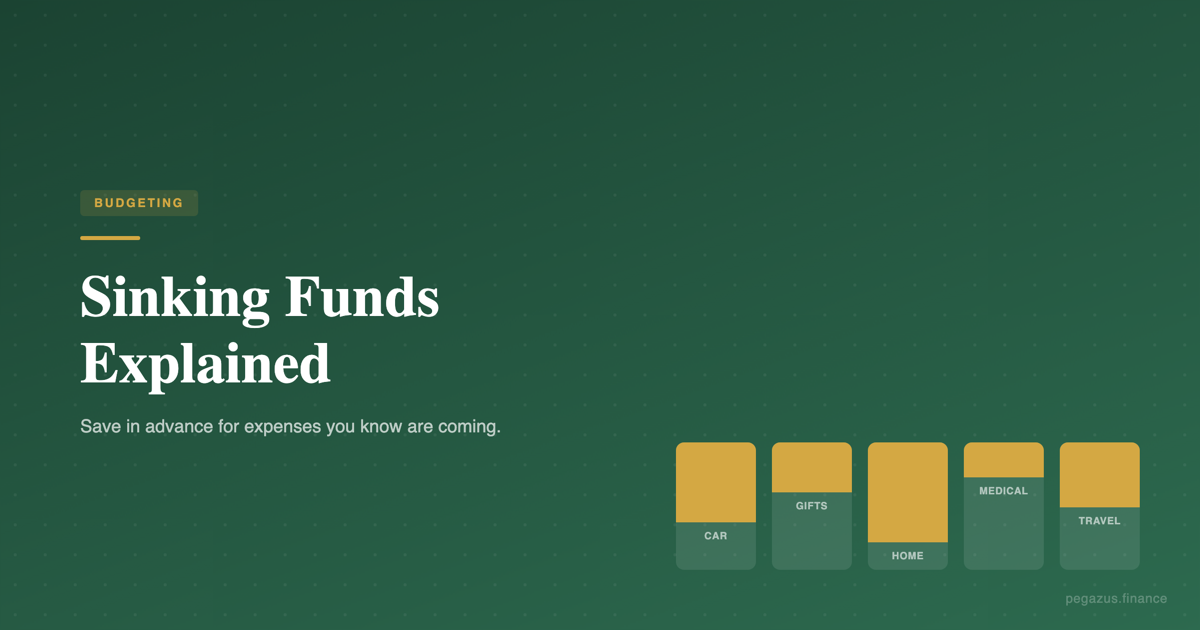
A sinking fund is money you save in advance for a known future expense. Unlike an emergency fund, which covers surprises, a sinking fund targets a specific cost you can predict: car repairs, holiday gifts, annual insurance premiums, or a vacation. Start by listing your irregular expenses, dividing each annual cost by 12, and automating that amount into a separate sub-account each month.
What is a sinking fund and how is it different from an emergency fund?
A sinking fund covers a planned expense. An emergency fund covers an unplanned one. Your car needing new tires every 40,000 miles is predictable. Your car getting rear-ended is not. The distinction matters because mixing the two leads to dipping into emergency savings for things you could have anticipated, which leaves you vulnerable when a real emergency hits.
The Consumer Financial Protection Bureau recommends separating savings by purpose to reduce the temptation to raid one goal for another. A sinking fund is not a luxury. It is how you prevent irregular expenses from blowing up your monthly budget. When your $1,200 insurance premium hits in March, you have already saved $100 per month for 12 months. The bill is just a transfer, not a crisis. I think sinking funds are the most underrated personal finance tool because they turn every “unexpected” expense into a line item you already planned for.
What are the most common sinking fund categories?
The right categories depend on your life, but most people need between 5 and 10. Start with the expenses that wreck your budget when they arrive. Car maintenance, holiday gifts, and annual insurance premiums are the three categories that catch the most people off guard. Add categories only for expenses over $200 per year; smaller amounts fold into regular monthly spending.
| Category | Estimated annual cost | Monthly contribution | Why it matters |
|---|---|---|---|
| Car maintenance and repairs | $1,200 to $1,800 | $100 to $150 | AAA reports average repair costs of $500 to $600 per incident |
| Holiday and birthday gifts | $600 to $1,200 | $50 to $100 | NRF data shows average holiday spending around $900 |
| Annual insurance premiums | $1,000 to $2,400 | $83 to $200 | Paying annually often saves 5 to 15% over monthly billing |
| Medical copays and deductibles | $500 to $2,000 | $42 to $167 | KFF reports average deductible of $1,735 for single coverage |
| Home maintenance | $1,200 to $3,600 | $100 to $300 | The 1% rule: budget 1% of home value per year for upkeep |
| Vacation | $1,000 to $3,000 | $83 to $250 | Prevents credit card debt from travel spending |
| Clothing and personal care | $600 to $1,200 | $50 to $100 | BLS reports average annual apparel spending of $1,945 |
| Electronics replacement | $300 to $800 | $25 to $67 | Phone, laptop, or appliance replacements on a cycle |
How do you calculate monthly sinking fund contributions?
Take the total cost you expect and divide it by the number of months until you need the money. If your car insurance premium is $1,400 and it renews in 10 months, save $140 per month. If you want $2,000 for a vacation in 8 months, save $250 per month. The math is simple division. The discipline is automating the transfer so you never have to think about it.
If you are starting from zero and multiple expenses are coming due soon, prioritize by impact. The 50/30/20 framework puts savings in the 20% bucket, but sinking funds are closer to “needs” because they cover things you will pay for regardless. According to a Federal Reserve survey, roughly 37% of Americans could not cover an unexpected $400 expense. Sinking funds directly solve this by converting large irregular costs into small regular deposits. Start with your three largest irregular expenses and add categories as your budget allows.
Where should you keep your sinking funds?
The best place is a high-yield savings account with sub-account features. Ally Bank calls them “buckets.” Capital One 360 calls them “savings goals.” SoFi calls them “vaults.” All three let you create labeled sub-accounts within one savings account, each earning interest, with no fees and no minimums. This keeps your sinking funds separated from each other and from your emergency fund.
When I last checked, Ally, Capital One, and SoFi all offered APYs above 4.00% on savings. That means your sinking fund money grows while it waits. A $3,000 vacation fund earning 4.50% APY gains about $135 over a year. Do not keep sinking funds in your checking account. The money will get spent. Physical separation, even within the same bank, creates a psychological barrier that research from the National Bureau of Economic Research confirms reduces impulsive withdrawals. Compare options in the guide to earning interest safely.
How do sinking funds fit into your monthly budget?
Treat sinking fund contributions as fixed expenses, not savings. They go in your budget by pay schedule alongside rent, utilities, and debt payments. When you plan your monthly budget, add a line item for each sinking fund and automate the transfer. This is non-negotiable money that has already been assigned to a future bill.
If your total sinking fund contributions exceed what you can afford, reduce the amounts rather than cutting categories entirely. Saving $25 per month toward car repairs is better than saving nothing and then scrambling when the mechanic hands you a $700 invoice. The CFPB emphasizes that even small, consistent savings habits improve financial resilience measurably. If you use a zero-based budget, sinking funds are simply categories in your plan. If you use 50/30/20, they split between needs (insurance, car) and wants (vacation, gifts) depending on the category.
Frequently Asked Questions
How many sinking fund categories should a beginner start with?
Start with three: car maintenance, holiday gifts, and your single largest annual bill (usually insurance). Add more categories after three months once you confirm the amounts are sustainable.
What happens if I need more than I saved in a sinking fund?
Pay the difference from your emergency fund or current month’s budget. Then increase the monthly contribution for that category going forward. Under-saving is normal in the first year as you learn your actual costs.
Should I use a separate bank account for each sinking fund?
No. Use sub-accounts (buckets or vaults) within one high-yield savings account. Opening separate bank accounts creates unnecessary complexity and makes it harder to track total savings.
Can I use a sinking fund for debt payoff?
A sinking fund works well for known lump-sum debt payments, such as saving to pay off a credit card balance in full by a target date. It does not replace a structured debt payoff plan for multiple debts.
Sources
- Consumer Financial Protection Bureau, “Your Money, Your Goals” Toolkit. Date checked: September 2026.
- Federal Reserve Board, “Report on the Economic Well-Being of U.S. Households.” Date checked: September 2026.
- Kaiser Family Foundation, “Employer Health Benefits Survey.” Date checked: September 2026.
- National Bureau of Economic Research, “Mental Accounting and Consumer Choice.” Date checked: September 2026.
- Bureau of Labor Statistics, “Consumer Expenditure Surveys.” Date checked: September 2026.