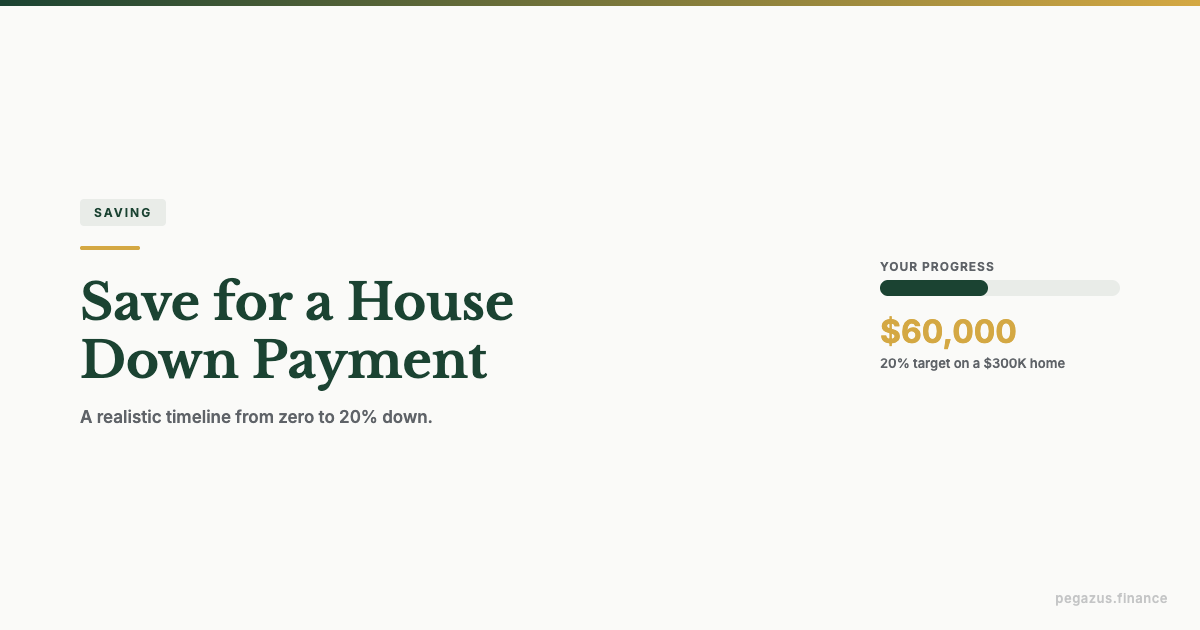
To save for a house down payment in two years, calculate your target based on home price and loan type (3% conventional, 3.5% FHA, or 20% to avoid PMI), then divide by 24 months. Park the money in a high-yield savings account earning 4.50% or more APY. For a $350,000 home with 10% down, that means saving $1,458 per month. Automate the transfer on payday and track progress monthly.
How much do you actually need for a down payment?
The answer depends on the loan program and whether you want to avoid private mortgage insurance (PMI). The 20% rule is a guideline, not a requirement. Most first-time buyers put down far less. According to the National Association of Realtors, the median down payment for first-time buyers was 8% when I last checked.
| Loan type | Minimum down | Down on $350,000 home | Monthly savings (24 months) | PMI? |
|---|---|---|---|---|
| Conventional | 3% | $10,500 | $438 | Yes, until 20% equity |
| FHA | 3.5% | $12,250 | $511 | Yes, for loan life (if <10% down) |
| Conventional 10% | 10% | $35,000 | $1,458 | Yes, until 20% equity |
| Conventional 20% | 20% | $70,000 | $2,917 | No |
| VA Loan | 0% | $0 | $0 | No (funding fee instead) |
| USDA Loan | 0% | $0 | $0 | Yes (guarantee fee) |
Add 2-5% of the purchase price for closing costs on top of the down payment. On a $350,000 home, closing costs run $7,000 to $17,500. Some of this is negotiable with the seller, but budget for at least $10,000 to avoid a surprise at the closing table. Your total savings target for a 10% down conventional loan on a $350,000 home is approximately $45,000 ($35,000 down + $10,000 closing costs).
Where should you keep a down payment fund?
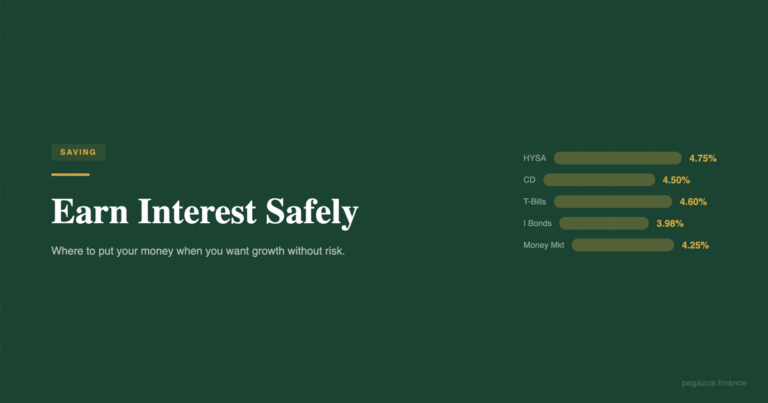
A high-yield savings account is the best vehicle for a two-year down payment fund. You need the money to be liquid (accessible without penalty), FDIC-insured, and earning competitive interest. When I last checked, the top HYSAs offered 4.50-5.00% APY.
Do not invest your down payment in the stock market. A two-year timeline is too short to recover from a correction. If the market drops 20% six months before you plan to buy, your $35,000 becomes $28,000 and your timeline resets. The SEC recommends keeping money you need within five years out of equities. Park it in a HYSA, earn your 4.50%, and accept that the return is lower but the certainty is absolute. See our full breakdown of safe interest-earning options for comparing HYSAs to CDs and Treasury bills.
How do you build a 24-month savings plan?
Start with your target number and work backward. Divide your total savings goal (down payment plus closing costs) by 24 months. That is your minimum monthly transfer. Set it as an automatic transfer from checking to your dedicated HYSA on the day after payday.
The plan looks like this for a $350,000 home with 10% down plus closing costs ($45,000 target):
- Months 1-3: Build the habit. Automate $1,875/month. Track spending to find cuts.
- Months 4-12: Optimize. Redirect tax refunds, bonuses, and side income directly to the fund.
- Months 13-18: Milestone check. You should be at 60-75% of your goal. If behind, increase the monthly amount or extend the timeline by 3 months.
- Months 19-24: Start the pre-approval process. Get your credit report from AnnualCreditReport.com. Do not open new credit lines or make large purchases.
If $1,875 per month feels impossible, revisit the down payment percentage. Dropping from 10% to 5% cuts your monthly savings to roughly $1,000. The trade-off is PMI, which adds $100-$250 per month to your mortgage payment. Run the numbers both ways using the CFPB’s homeownership tools.
What first-time buyer programs help with down payments?
Every state offers some form of down payment assistance for first-time buyers. These programs are underused because most buyers do not know they exist. The U.S. Department of Housing and Urban Development (HUD) maintains a state-by-state directory of approved housing counseling agencies that can connect you with local programs.
Common program types include forgivable loans (repaid only if you sell within 5-10 years), matched savings programs (the state matches your savings 2:1 or 3:1), and tax credit certificates that reduce your federal tax liability for the life of the loan. Income limits apply, but they are higher than most people expect. Many programs cover households earning up to 120% of the area median income. FHA loans are particularly useful for first-time buyers because the 3.5% minimum down payment can come entirely from gift funds or down payment assistance programs. Your savings strategy guide covers broader approaches to building the fund itself.
Should you delay buying to save a larger down payment?
This is the hardest question in the process, and the answer depends on your local market. If home prices in your area are rising faster than your savings rate, waiting costs you money. NAR data shows that the median existing home price has increased an average of 5-6% per year nationally over the past decade. On a $350,000 home, that is $17,500-$21,000 in price appreciation per year.
My opinion: buy with 5-10% down if you can comfortably afford the monthly payment (including PMI) on 28% or less of your gross income. The PMI cost is real but temporary. Once you reach 20% equity through payments and appreciation, request cancellation. Waiting two extra years to hit 20% down often costs more in price appreciation than you save in avoided PMI. The monthly savings guide can help you figure out whether your budget supports the mortgage payment alongside your other financial goals.
Frequently Asked Questions
Can you use retirement savings for a down payment?
You can withdraw up to $10,000 from a traditional IRA penalty-free for a first home purchase. Roth IRA contributions (not earnings) can be withdrawn any time without penalty. However, raiding retirement savings delays compounding, which costs far more long-term than PMI.
Does a larger down payment get you a better interest rate?
Sometimes. Lenders may offer slightly better rates at 10% or 20% down because the loan-to-value ratio is lower. The difference is typically 0.125-0.25 percentage points, which matters over 30 years but is not dramatic enough to justify delaying a purchase.
How much does PMI actually cost?
PMI typically costs 0.5-1.5% of the original loan amount per year. On a $315,000 loan (90% of $350,000), that is $131-$394 per month. The exact rate depends on your credit score and down payment percentage. It is automatically removed when you reach 22% equity.
Should you save separately for a down payment and an emergency fund?
Yes. Never use your emergency fund as your down payment. Homeownership brings unexpected expenses immediately: repairs, appliances, maintenance. Keep 3 months of expenses in a separate emergency fund before buying.
Sources
- National Association of Realtors, “Profile of Home Buyers and Sellers,” nar.realtor. Date checked: August 2026.
- Consumer Financial Protection Bureau, “Owning a Home Tools,” consumerfinance.gov. Date checked: August 2026.
- U.S. Department of Housing and Urban Development, “Buying a Home,” hud.gov. Date checked: August 2026.
- SEC, “Saving and Investing Guide,” sec.gov. Date checked: August 2026.
- AnnualCreditReport.com, free credit report access. Date checked: August 2026.
Pegazus Finance is not a financial advisor or mortgage lender. Content is informational only. See our methodology and disclaimer.