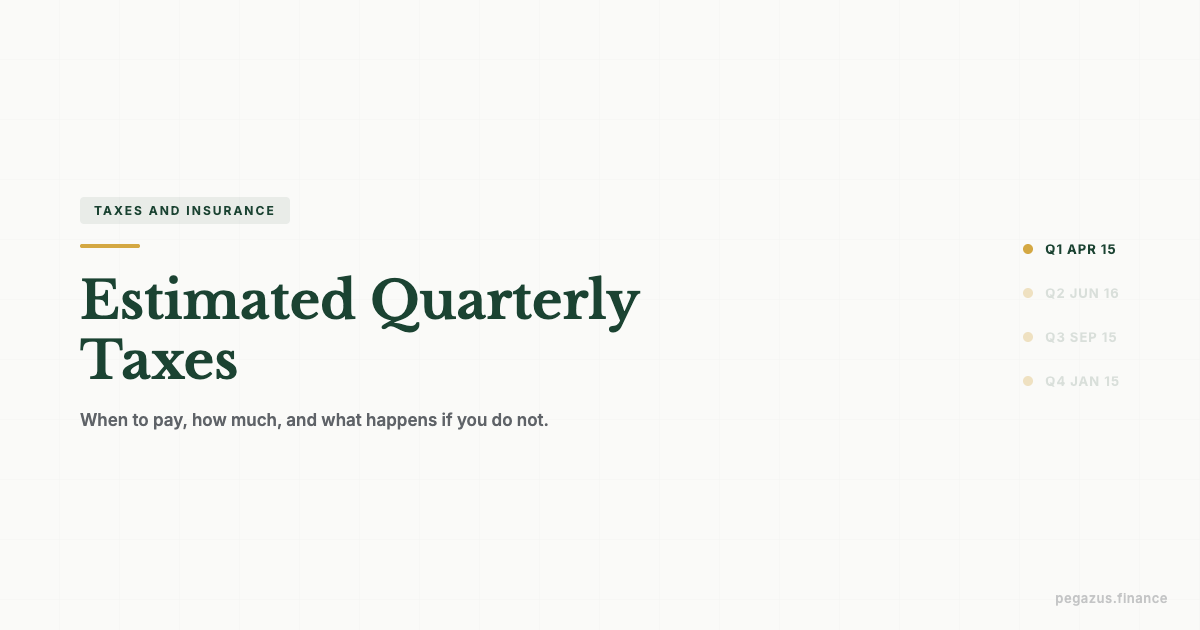
Freelancers must pay estimated quarterly taxes four times per year using Form 1040-ES. The IRS expects payment by April 15, June 16, September 15, and January 15. To avoid an underpayment penalty, pay at least 90% of your current year tax or 100% of last year’s total (110% if your adjusted gross income exceeds $150,000). Use IRS Direct Pay or EFTPS to submit each payment.
What are estimated quarterly taxes and who has to pay them?
Estimated quarterly taxes are prepayments on income that has no withholding. The IRS requires them from anyone who expects to owe $1,000 or more when filing. If you freelance, run a sole proprietorship, or earn significant investment income, you almost certainly qualify.
W-2 employees avoid this because their employer withholds federal income tax, Social Security, and Medicare from every paycheck. Freelancers have no employer doing that work. The IRS still expects its money throughout the year, not in one lump sum on April 15. According to the IRS estimated tax page, you use Form 1040-ES to calculate and submit each payment. Self-employment tax alone adds 15.3% on top of your income tax rate, so the amounts are larger than most new freelancers expect.
When are the four quarterly due dates?
The IRS quarterly schedule does not follow calendar quarters evenly. The four due dates when I last checked are April 15, June 16, September 15, and January 15 of the following year. Missing any deadline triggers a penalty calculated per day on the underpaid amount.
The second quarter is the shortest gap, covering only two months of income (April and May). Many freelancers trip up here because they assume each quarter covers three months. Mark these dates in your calendar the day you start freelancing. The IRS does not send reminders. If a due date falls on a weekend or holiday, the deadline shifts to the next business day. State estimated taxes often share the same dates, but some states like California use different schedules. Check your state’s department of revenue website separately.
| Quarter | Income Period | Federal Due Date | Payment Covers |
|---|---|---|---|
| Q1 | Jan 1 to Mar 31 | April 15 | 3 months of income |
| Q2 | Apr 1 to May 31 | June 16 | 2 months of income |
| Q3 | Jun 1 to Aug 31 | September 15 | 3 months of income |
| Q4 | Sep 1 to Dec 31 | January 15 | 4 months of income |
How do you calculate how much to pay each quarter?
The simplest approach is the safe harbor method. Pay either 100% of last year’s total tax divided by four, or 90% of your expected current year tax divided by four. If your adjusted gross income exceeded $150,000 last year, the safe harbor threshold rises to 110% of last year’s tax. Meeting either safe harbor eliminates the underpayment penalty regardless of what you actually owe at filing.
For a more precise calculation, estimate your total freelance income for the year, subtract business deductions (home office, equipment, software, health insurance premiums), then apply your marginal tax rate plus the 15.3% self-employment tax rate. Divide that total by four. The IRS provides a worksheet in Form 1040-ES that walks through each step. Many freelancers set aside 25% to 30% of each payment they receive into a separate savings account dedicated to taxes. That buffer catches most scenarios without requiring precise projections.
What is the easiest way to actually submit a payment?
IRS Direct Pay is the fastest free option. You enter your bank account details, select “Estimated Tax” as the payment reason, choose the correct tax year and quarter, and confirm. The payment processes immediately with no fees. EFTPS (Electronic Federal Tax Payment System) requires enrollment in advance but lets you schedule payments ahead of time.
The IRS2Go mobile app connects to both Direct Pay and EFTPS. You can also pay by credit or debit card through approved processors, but they charge a processing fee of 1.85% to 1.98% for credit cards. That fee rarely makes sense unless you are earning significant credit card rewards. Mailing a check with a Form 1040-ES voucher still works but is the slowest and least trackable method. I recommend Direct Pay for most freelancers because it provides instant confirmation and costs nothing. Keep every confirmation number in a dedicated folder. The IRS sometimes loses payment records, and the confirmation is your proof.
What happens if you underpay or miss a deadline?
The IRS charges an underpayment penalty calculated using the federal short-term interest rate plus three percentage points, applied per day on each missed or underpaid quarter. When I last checked, the penalty rate was approximately 8% annualized. The penalty is calculated on Form 2210 when you file your annual return.
The penalty is not catastrophic for small shortfalls. If you underpay one quarter by $500, the annualized penalty on that amount is roughly $40. But consistent underpayment across all four quarters on a $60,000 freelance income adds up. The IRS may waive the penalty in certain situations: if you owed less than $1,000 at filing, if your withholding and estimated payments covered at least 90% of the current year tax, or if you met the safe harbor threshold. First-time freelancers who had no tax liability in the prior year are also exempt from the penalty for their first year of estimated payments.
Which deductions reduce your quarterly payment amount?
Deducting legitimate business expenses before calculating your estimated tax lowers every quarterly payment. The home office deduction under the simplified method allows $5 per square foot up to 300 square feet, giving a maximum $1,500 deduction with no receipts required. Internet and phone bills are deductible at the percentage used for business.
The qualified business income (QBI) deduction under Section 199A lets most freelancers deduct 20% of their net business income from taxable income. This single deduction can reduce your effective tax rate by several percentage points. Self-employed health insurance premiums are deductible on your personal return, not just Schedule C. Equipment, software subscriptions, professional development, and travel for client meetings are all deductible. Keep records as you go rather than reconstructing them at tax time. A simple spreadsheet or an app like Wave (free) tracks income and expenses well enough for most solo freelancers.
Frequently Asked Questions
Can I pay all my estimated taxes at once instead of quarterly?
Yes. You can pay your entire estimated annual tax with the Q1 payment in April. The IRS does not penalize overpayment. However, this ties up cash early in the year that could earn interest in a high-yield savings account.
Do I still need to pay quarterly taxes if I also have a W-2 job?
It depends on whether your W-2 withholding covers your total tax liability including freelance income. You can increase your W-2 withholding using Form W-4 to cover the freelance portion, which eliminates the need for separate quarterly payments.
What if my freelance income is very uneven throughout the year?
Use the annualized income installment method on Schedule AI of Form 2210. This calculates each quarter’s payment based on actual income received during that period rather than dividing equally by four.
Do I need to pay state estimated taxes too?
If your state has an income tax, yes. Most states follow the same quarterly schedule as the IRS, but the forms and payment portals are separate. Check your state’s department of revenue website for specific instructions and deadlines.
Sources
- IRS, “Estimated Taxes,” irs.gov. Date checked: Sep 2026.
- IRS, “About Form 1040-ES,” irs.gov. Date checked: Sep 2026.
- IRS, “About Form 2210,” irs.gov. Date checked: Sep 2026.
- IRS, “Direct Pay,” irs.gov. Date checked: Sep 2026.
- IRS, “Qualified Business Income Deduction,” irs.gov. Date checked: Sep 2026.
- IRS, “Self-Employed Individuals Tax Center,” irs.gov. Date checked: Sep 2026.
This article is for informational purposes only and does not constitute tax advice. Consult a qualified tax professional for guidance specific to your situation. Read our full disclaimer.