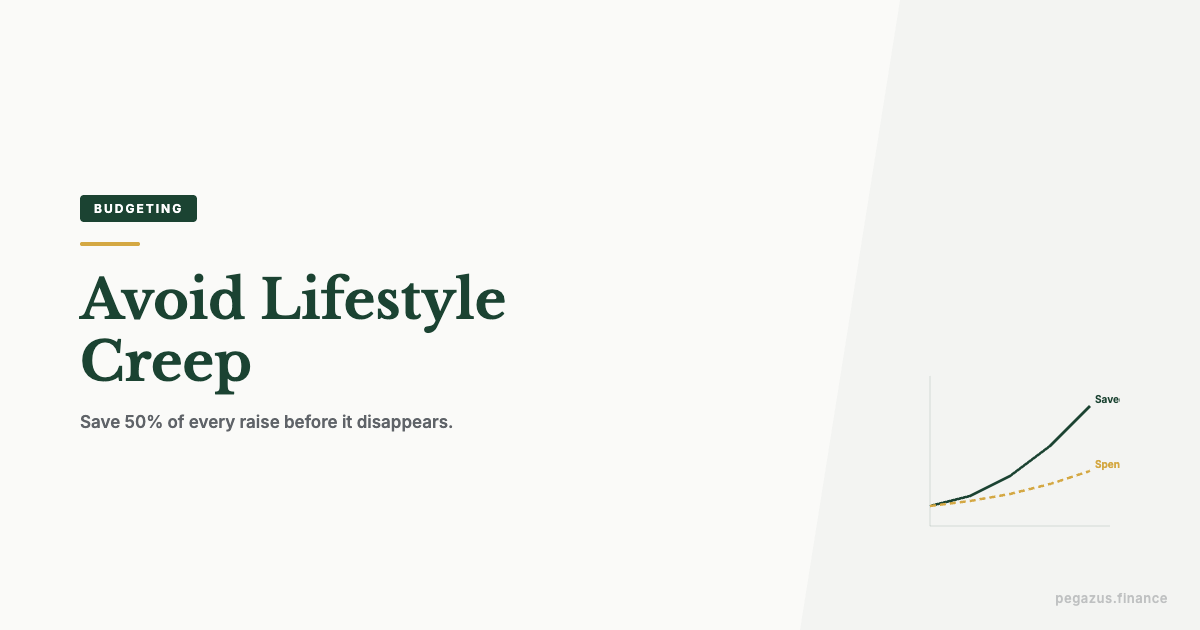
The most effective way to prevent lifestyle creep is to automate savings increases before a raise hits your checking account. Redirect at least half of every raise into retirement contributions, a high-yield savings account, or investment accounts. When the extra money never enters your day-to-day spending, your lifestyle stays anchored to your previous income while your wealth grows faster.
What is lifestyle creep and why does it happen?
Lifestyle creep is the gradual increase in spending that follows an increase in income. You earn more, so you spend more. The phenomenon is driven by what behavioral economists call the hedonic treadmill: humans adapt quickly to improved circumstances and return to a baseline level of satisfaction. A nicer apartment feels exciting for a month, then it feels normal. The same applies to a newer car, more frequent dining out, and upgraded subscriptions.
The danger is not that any single upgrade is irresponsible. It is that the cumulative effect of many small upgrades erases the wealth-building power of higher income. According to the Bureau of Labor Statistics, households earning $100,000 to $150,000 save roughly the same percentage of income as households earning $70,000 to $100,000. Higher earners spend more on housing, transportation, and food away from home. Their savings rate barely moves despite earning significantly more.
How does the 50/50 raise rule work?
The 50/50 raise rule is simple: save at least half of every raise, bonus, or income increase before adjusting your lifestyle. If you receive a $5,000 annual raise, direct $2,500 into savings or investments immediately. The remaining $2,500 is yours to enjoy guilt-free. This approach works because it acknowledges human psychology. Complete deprivation fails. Allowing yourself to enjoy some of the increase while capturing the rest for wealth building is sustainable long-term.
The math compounds aggressively. Here is what saving 50% of annual raises looks like over 10 years assuming a 3% annual salary increase and 8% investment returns:
| Starting Salary | Annual Raise (3%) | 50% of Raises Saved | Invested Value at 10 Years |
|---|---|---|---|
| $50,000 | $1,500/yr | $750/yr | ~$11,700 |
| $65,000 | $1,950/yr | $975/yr | ~$15,200 |
| $80,000 | $2,400/yr | $1,200/yr | ~$18,700 |
| $100,000 | $3,000/yr | $1,500/yr | ~$23,400 |
These numbers assume the raise amount stays fixed each year for simplicity. In practice, raises compound on each other. A person earning $80,000 who saves half of every 3% raise for 10 years accumulates nearly $19,000 in additional investments without ever feeling like they cut back.
What are the biggest lifestyle creep categories to watch?
Housing is the largest creep category. Moving to a more expensive apartment or house after a raise is the single decision most likely to lock in higher spending for years. A $300 per month rent increase costs $3,600 per year and is difficult to reverse. Before upgrading housing, calculate whether the increase stays below 25% of your take-home pay. If it pushes above 30%, the upgrade is eating your raise entirely.
Transportation is next. A new car payment of $500 to $700 per month, plus higher insurance and depreciation, can absorb an entire raise. The BLS Consumer Expenditure Survey shows that households earning over $100,000 spend an average of $12,000 per year on vehicle costs. Dining and subscriptions are smaller per item but accumulate silently. A $15 lunch five days a week costs $3,900 per year. Five streaming services, a gym membership, and a meal kit delivery add another $300 per month.
How do you automate savings so you never see the money?
The key is making the saving happen before the money reaches your primary checking account. Increase your 401(k) contribution percentage the same week you learn about a raise. If your employer allows it, split your direct deposit so a fixed amount goes straight into a high-yield savings account and the rest goes to checking. Set up automatic transfers on payday to a brokerage account. When the raise never shows up in your spending account, you cannot spend it.
The pay-yourself-first approach treats savings as a non-negotiable expense rather than whatever is left over at the end of the month. Behavioral research consistently shows that people who automate savings build wealth faster than those who rely on willpower alone. The specific order matters: first max the employer match on your 401(k), then fund a Roth IRA, then add to taxable investment accounts.
Is all lifestyle creep bad?
No. Some spending increases genuinely improve your quality of life and are worth the cost. Moving closer to work to eliminate a 90-minute commute is a valid use of a raise. Hiring a house cleaner to reclaim weekend hours has real value. Upgrading from a failing car to a reliable one reduces stress and repair costs. The distinction is between intentional upgrades you planned and mindless drift where you cannot identify where the money went.
The test is awareness. If you can name each new recurring expense, explain why it matters to you, and confirm it fits within a spending plan that still saves 20% or more of your income, that is conscious spending. If your bank balance at the end of the month is the same despite earning $10,000 more this year, and you cannot explain why, that is lifestyle creep.
Frequently Asked Questions
What percentage of a raise should you save?
Save at least 50%. If you are behind on retirement savings or carrying high-interest debt, save 75% or more until you catch up.
How do you reverse lifestyle creep that already happened?
Audit your recurring expenses. Cancel subscriptions you forgot about. Downgrade services you do not fully use. Redirect the freed cash to savings automatically.
Does lifestyle creep affect high earners more?
Yes. Research shows that spending increases proportionally with income across all brackets. High earners have more categories where creep can hide.
Can a budget app help prevent lifestyle creep?
Tracking tools like YNAB or Monarch Money make spending visible. Visibility alone reduces mindless spending, though automation is still the strongest defense.
Sources
Date checked: September 2026
This content is for informational purposes only and does not constitute financial advice. Read our full disclaimer and learn about how we research.