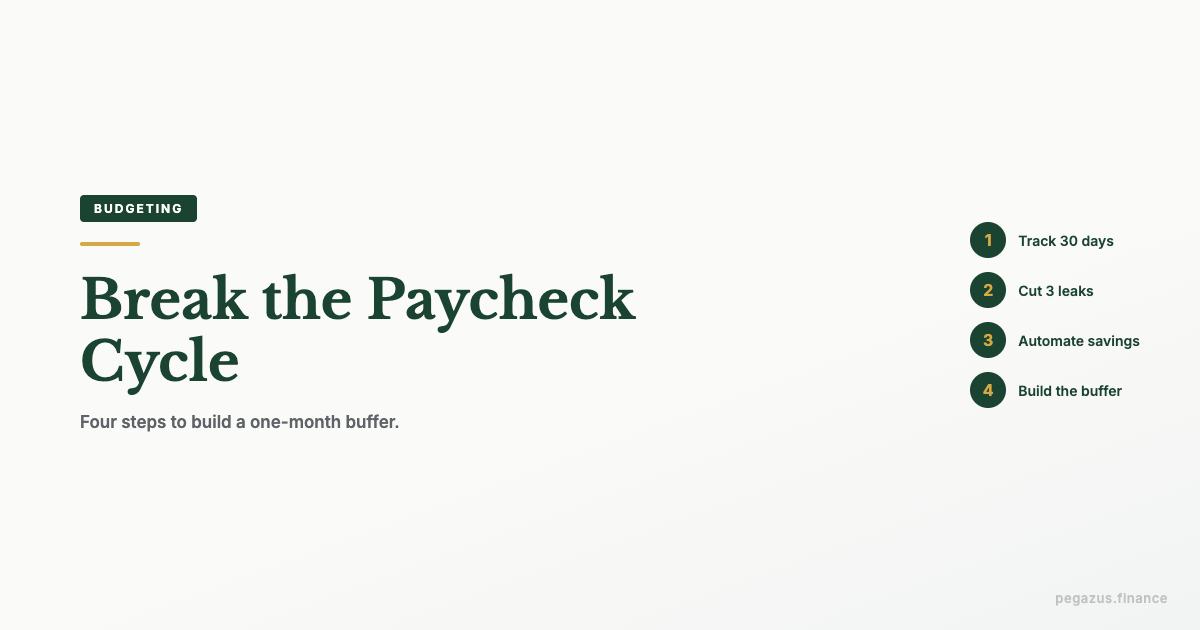
Stop living paycheck to paycheck by building a one-month buffer: save enough to pay this month’s bills with last month’s income. Start by tracking every dollar for 30 days, identify your three biggest discretionary spending leaks, automate a savings transfer on payday before you spend, and build the buffer over four to six months. A Bureau of Labor Statistics survey shows the average household has three to five categories where small cuts produce $200 to $500 per month in savings without a dramatic lifestyle change.
Why do so many people live paycheck to paycheck even with decent incomes?
The paycheck-to-paycheck cycle is not just a low-income problem. According to data from the Federal Reserve, roughly 37% of households earning over $100,000 still report difficulty covering an unexpected $400 expense. The issue is almost always spending expansion, not insufficient income. As earnings rise, housing upgrades, car payments, subscription services, and dining out absorb the increase before savings get a chance.
The structural problem is timing. Most people spend first and save whatever is left, which is usually nothing. The fix is reversing that order: save and pay debt obligations first, then spend what remains. This is the pay-yourself-first principle, and it works because it removes the decision from your daily routine. The one-month buffer concept makes this concrete. Instead of vaguely hoping to save more, you have a specific target: accumulate one full month of essential expenses so you are always paying bills with money you earned 30 days ago.
How do you track spending to find the leaks?
For 30 days, record every transaction. Use a free app like Mint, YNAB’s trial, or a simple spreadsheet. Categorize each purchase: housing, food (groceries vs. dining out), transportation, subscriptions, entertainment, clothing, and miscellaneous. The goal is not to judge your spending but to see it clearly. Most people discover $300 to $600 per month in spending they did not realize was happening.
The most common leaks for households earning $40,000 to $80,000 are dining out and delivery ($250 to $500/month average per BLS data), unused or forgotten subscriptions ($50 to $150/month), impulse purchases on Amazon or similar ($100 to $300/month), and convenience fees like ATM charges and rush shipping. You do not need to eliminate all discretionary spending. Cutting the top three leaks by 50% typically frees $200 to $400 per month, which is enough to build a working budget and start the buffer.
| Spending Category | Average Monthly Leak | Realistic Cut (50%) | Annual Savings |
|---|---|---|---|
| Dining out and delivery | $350 | $175 | $2,100 |
| Unused subscriptions | $85 | $85 (cancel all unused) | $1,020 |
| Impulse online shopping | $200 | $100 | $1,200 |
| Convenience fees (ATM, rush ship) | $40 | $30 | $360 |
| Premium grocery upgrades | $120 | $60 | $720 |
| Total potential savings | $795 | $450 | $5,400 |
What is the one-month buffer and how do you build it?
The one-month buffer means having enough cash in your checking or savings account to cover all of next month’s essential expenses before the month begins. If your rent, utilities, groceries, insurance, minimum debt payments, and transportation cost $3,200 per month, your buffer target is $3,200. This is different from an emergency fund. The buffer handles normal monthly expenses; the emergency fund covers surprises.
Build it in stages. Month one: save $400 from the spending cuts you identified. Month two: save another $400 plus any windfalls (tax refund, bonus, side income). Month three and four: continue at $400 to $600 per month. By month five or six, you should have the full buffer. Once it is in place, you stop living on this week’s paycheck. You spend last month’s money on this month’s bills, and this month’s paycheck goes into next month’s pool. The stress reduction is immediate. Bills due on the 1st no longer depend on a paycheck arriving on the 30th.
How does automating your finances break the cycle?
On each payday, set up automatic transfers in this order: first, savings (buffer or emergency fund). Second, extra debt payment above minimums. Third, the rest stays in checking for spending. This is the core principle behind the pay schedule budgeting method. The automation means you never have to decide whether to save this month. The decision was made once, and the bank executes it every two weeks.
Most banks let you schedule recurring transfers for free. Set the savings transfer for the same day your direct deposit arrives. If you get paid biweekly and want to save $200 per paycheck, that is $5,200 per year. Even $50 per paycheck ($1,300/year) compounds into a meaningful buffer within six months. The key insight is that saving before spending works because you adapt your lifestyle to the remaining amount. Saving after spending fails because there is never anything left.
What about increasing income instead of just cutting expenses?
Expense cuts have a floor. Income growth does not. Once you have plugged the obvious leaks, the faster path to breaking the cycle is earning more. Three high-impact strategies work for most people in the $40,000 to $70,000 range. First, negotiate your current salary. According to a Glassdoor survey, only 37% of workers have ever negotiated pay, and those who do earn an average of 7% more. Second, develop a marketable skill. Free resources from Coursera, Google Certificates, and community colleges can add $5,000 to $15,000 in annual earning potential within six to twelve months.
Third, structured side income. Not gig work that trades time for minimum wage, but services that leverage your existing skills: freelance writing, bookkeeping, tutoring, web development, or consulting in your professional area. Even $500 per month in side income directed entirely to the buffer can close the gap in two to three months. The saving strategies guide covers how to allocate extra income once the buffer is built.
Frequently Asked Questions
How long does it take to stop living paycheck to paycheck?
With consistent effort and $300 to $500 per month in savings from spending cuts or extra income, most people build a one-month buffer in four to six months. The psychological shift happens sooner, usually after the first full month where bills are paid without checking your bank balance.
Should I pay off debt or build the buffer first?
Build a $1,000 starter emergency fund first, then split extra money between the buffer and debt. The buffer prevents new debt from forming. Without it, every unexpected expense goes on a credit card and the cycle continues.
What if my income is genuinely too low to save anything?
If after cutting all discretionary spending you still cannot cover essentials, the problem is structural income, not budgeting. Pursue SNAP benefits, utility assistance programs (LIHEAP), and earned income tax credits while actively working on income growth through skill development or job changes.
Does the 50/30/20 rule work for breaking the paycheck-to-paycheck cycle?
It is a good starting framework, but most paycheck-to-paycheck households need a higher savings rate initially. Consider a temporary 50/20/30 split (needs/savings+debt/wants) until the buffer is built. Then relax back to 50/30/20 for long-term sustainability.
Sources
- Federal Reserve Board, “Report on the Economic Well-Being of U.S. Households.” Date checked: September 2026.
- Bureau of Labor Statistics, Consumer Expenditure Survey. Date checked: September 2026.
- Glassdoor, “Salary Negotiation Guide and Statistics.” Date checked: September 2026.