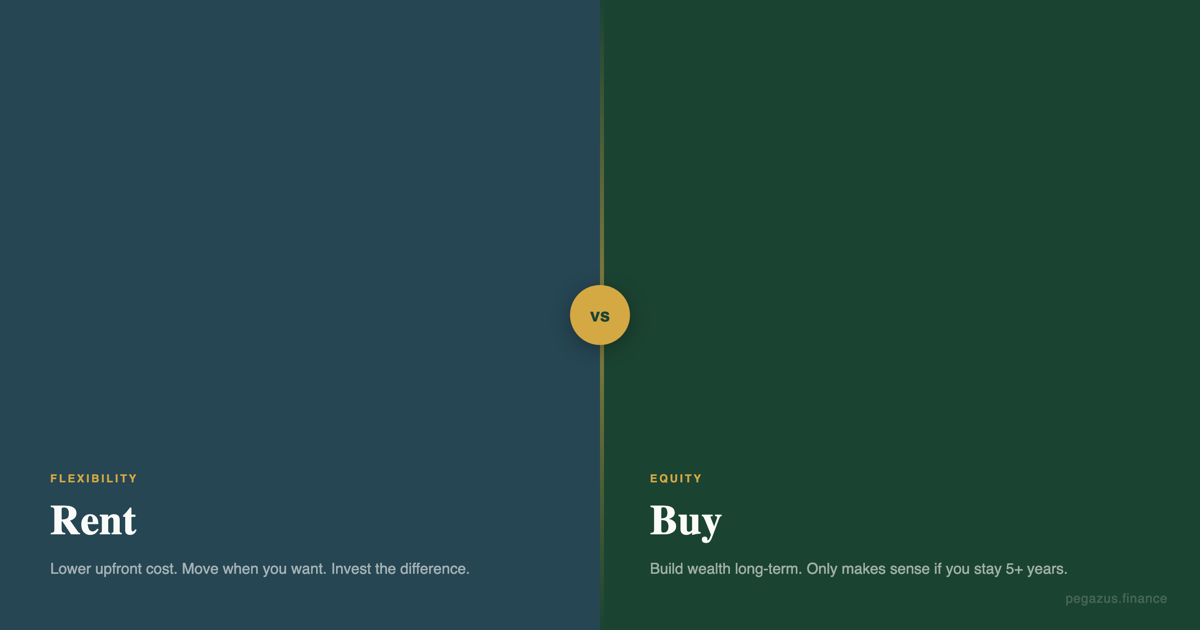
Renting is the better financial choice for most people in their 20s unless you plan to stay in one place for at least five years, have a stable income, and can afford a 10-20% down payment without draining your emergency fund. Buying a home before you are financially ready often costs more in closing fees, maintenance, and lost investment returns than renting and investing the difference.
What is the five-year rule and why does it matter so much?
The five-year rule is the minimum time you need to own a home before selling to break even on transaction costs. When you buy, you pay 2-5% of the purchase price in closing costs. When you sell, you pay 6-10% in agent commissions, transfer taxes, and selling costs. On a $350,000 home, that is roughly $28,000 to $52,000 in costs that produce zero equity.
In the first years of a mortgage, the majority of your payment goes toward interest, not principal. On a 30-year fixed mortgage at 6.5%, only about 25% of your monthly payment reduces the loan balance in Year 1. You need appreciation and principal paydown to overcome those transaction costs. According to data from the Federal Housing Finance Agency House Price Index, national home prices have averaged roughly 3-4% annual appreciation over the past three decades. At that rate, five years is typically the breakeven point.
If your 20s involve job changes, relocations, graduate school, or relationship shifts, that five-year commitment is hard to guarantee. Selling early often means losing money or being trapped in a home you cannot afford to leave.
How do the total costs actually compare over time?
Most rent-vs-buy comparisons miss the hidden costs of homeownership that renters avoid entirely. Property taxes, homeowner’s insurance, maintenance, and repairs add 2-4% of the home’s value per year on top of your mortgage payment.
| Cost category | Renting ($1,700/mo) | Buying ($350K, 6.5% rate) |
|---|---|---|
| Monthly housing payment | $1,700 rent | $1,990 mortgage (P+I) |
| Property tax (annual) | $0 | $3,500 (~1% of value) |
| Homeowner’s insurance (annual) | $0 (renter’s ~$180/yr) | $1,400 |
| Maintenance and repairs (annual) | $0 | $3,500-$7,000 (1-2% of value) |
| PMI (if under 20% down) | $0 | $145/month until 20% equity |
| HOA fees (if applicable) | $0 | $200-$400/month |
| Closing costs (purchase) | $0 | $10,500 (3%) |
| Total Year 1 cost | $20,580 | $36,680-$40,180 |
The $35,000 down payment a buyer puts toward the home could instead be invested. At a 7% average annual return in a diversified index fund, $35,000 grows to roughly $49,000 in five years. This opportunity cost is real money that the rent-vs-buy calculators from financial planning sites often undercount.
What is the price-to-rent ratio and how do you use it?
The price-to-rent ratio divides the median home price by the annual cost of renting a comparable property. When I last checked, the national ratio hovered around 18 to 20, but it varies dramatically by city. A ratio below 15 favors buying. A ratio above 20 favors renting. Above 25, renting is almost always the smarter financial move.
According to the U.S. Census Bureau Housing Vacancies and Homeownership data, several major metros where young professionals cluster have price-to-rent ratios well above 25: San Francisco, Los Angeles, New York, Seattle, and Denver. In these cities, the math overwhelmingly favors renting and investing the difference. Meanwhile, cities like Cleveland, Memphis, and Pittsburgh often fall below 15, where buying makes more sense even for short-term residents.
When does buying actually make sense in your 20s?
Buying in your 20s is the right call if you meet all four conditions: you plan to stay put for at least five years, you have a stable income with low risk of job-related relocation, you can afford a down payment of at least 10% (ideally 20% to avoid PMI) without emptying your emergency fund, and the price-to-rent ratio in your area is below 20.
The biggest financial advantage of buying young is time. A 25-year-old who buys and stays put can have a paid-off mortgage by 55, eliminating their largest monthly expense before traditional retirement age. The Federal Reserve Survey of Consumer Finances consistently shows that homeowner median net worth is roughly 40 times higher than renter median net worth, though this correlation reflects income differences and forced savings through mortgage payments, not homeownership magic.
House hacking is another reason buying makes sense early. Purchasing a duplex or a home with a rentable unit through an FHA loan (3.5% down, owner-occupied) lets you offset your mortgage with rental income while building equity. This strategy works best in markets where rent covers 50% or more of the mortgage.
What about building wealth through equity?
Home equity is real wealth, but it is illiquid and concentrated in a single asset. Renters who invest the difference between rent and the full cost of ownership often end up with comparable or greater net worth after 10 years, depending on market conditions and investment returns.
My honest take: the “renting is throwing money away” line is one of the most damaging pieces of financial advice circulating today. Renting is paying for flexibility, zero maintenance responsibility, and the ability to invest the difference in diversified assets. Buying is paying for forced savings, potential appreciation, and housing cost stability. Neither is inherently better. The right choice depends on your specific numbers, your local housing market, and how certain you are about staying put.
Frequently Asked Questions
Is the mortgage interest deduction a good reason to buy?
For most buyers in their 20s, no. The standard deduction (roughly $15,000 for single filers when I last checked) exceeds the itemized mortgage interest deduction for loans under $375,000. You only benefit if your total itemized deductions exceed the standard deduction, which typically requires a large mortgage, high state taxes, or significant charitable giving.
How much should I have saved before buying a first home?
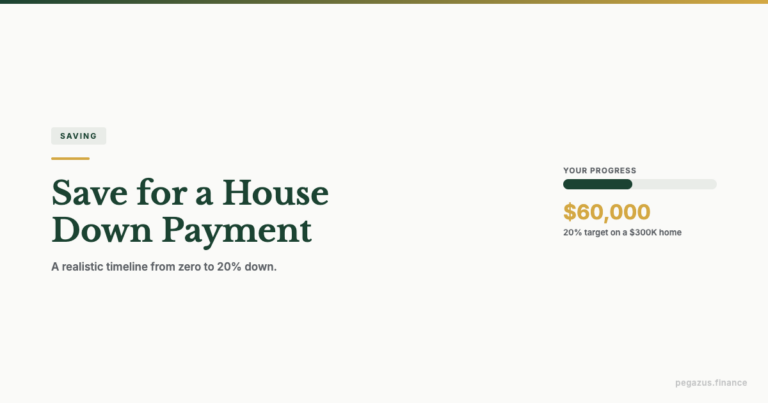
At minimum: 10% down payment, 3-5% for closing costs, a fully funded emergency fund of three to six months of expenses, and enough left over to furnish and maintain the home. For a $300,000 home, that is roughly $45,000 to $60,000 in total savings before you are truly ready.
Does renting really let you invest more than buying?
Only if you actually invest the difference. The strategy works on paper, but it requires discipline. Set up automatic monthly transfers to a brokerage account equal to the difference between your rent and what your total housing costs would be as a buyer. Without that step, the money disappears into lifestyle spending.
What about building credit through a mortgage?
A mortgage does strengthen your credit mix and history length. However, you can build excellent credit through responsible credit card use and installment loans without taking on a six-figure debt obligation. Do not buy a house solely to improve your credit score.
Sources
- Federal Housing Finance Agency, House Price Index — fhfa.gov
- U.S. Census Bureau, Housing Vacancies and Homeownership — census.gov
- Federal Reserve, Survey of Consumer Finances — federalreserve.gov
- FHA Loan Limits and Requirements — fha.com
Date checked: September 2026
This article is for informational purposes only and does not constitute financial advice. See our full disclaimer and research methodology.