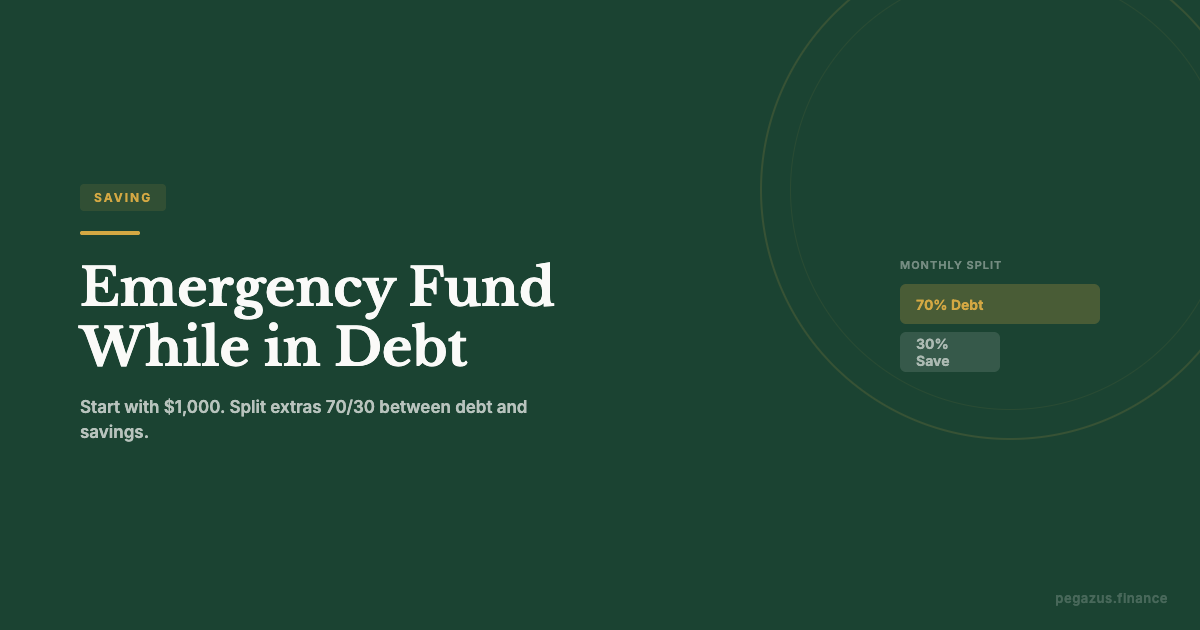
Start with a $1,000 starter emergency fund before aggressively paying down debt. This small buffer prevents new debt from surprise expenses like car repairs or medical copays. Once high-interest debt is gone, build the fund to three to six months of essential expenses in a high-yield savings account earning 4.50% or more APY. The starter fund is not optional. It is the foundation that keeps your debt payoff plan from collapsing.
Why should you build an emergency fund before paying off all your debt?
An emergency fund while carrying debt sounds counterintuitive, but skipping it is the most common reason debt payoff plans fail. According to a Federal Reserve survey, 37% of Americans cannot cover a $400 emergency with cash. Without a buffer, every unexpected expense goes on a credit card and adds to the balance you are trying to eliminate.
The math confirms this. A $500 car repair on a credit card at 24% APR costs $620 if paid over a year. That same $500 sitting in a high-yield savings account earns interest while protecting your payoff timeline. The $1,000 starter fund costs you roughly $50 in foregone debt interest over two months. A single emergency without it can set you back six months.
Financial planners at the Consumer Financial Protection Bureau recommend building a small cash reserve even during active debt repayment. The goal is not perfection. The goal is a firewall between your progress and life’s randomness.
How much should your starter emergency fund be?
The standard recommendation is $1,000, and for most people earning under $60,000 that number works. It covers the most common emergencies: a minor car repair, an urgent dental visit, a broken appliance, or a last-minute flight for a family emergency. The Bureau of Labor Statistics Consumer Expenditure Survey shows the median unexpected expense falls between $400 and $1,200.
If your monthly essential expenses exceed $3,000 or you have dependents, consider a $1,500 to $2,000 starter fund instead. The point is speed. You should be able to save this amount in four to eight weeks by temporarily cutting discretionary spending. Sell items you do not need, skip dining out, pause subscriptions. This is a sprint, not a lifestyle change. Once the starter fund is in place, redirect every extra dollar toward your highest-interest debt.
Should you split extra money between debt and savings or focus on one?
After the starter fund is set, two schools of thought compete. The sequential approach, popularized by Dave Ramsey’s Baby Steps, says attack debt with full intensity and build the larger fund only after becoming debt-free. The balanced approach splits extra money roughly 70/30 toward debt and savings simultaneously.
The balanced approach is the better choice for most people. Here is why: a fully sequential strategy works if your debt payoff takes under 12 months. Beyond that, the risk of a larger emergency draining your $1,000 buffer and restarting the cycle is too high. A 70/30 split means your debt payoff takes slightly longer, but your savings account grows in parallel. By the time the debt is gone, you already have a meaningful fund instead of starting from zero.
| Debt Type | Interest Rate | Priority | Savings Split |
|---|---|---|---|
| Payday loans | 300%+ | Eliminate immediately | 100% to debt until gone |
| Credit cards | 20-28% | High priority | 80/20 debt/savings |
| Personal loans | 8-15% | Medium priority | 70/30 debt/savings |
| Auto loans | 5-9% | Lower priority | 60/40 debt/savings |
| Student loans (federal) | 5-7% | Lower priority | 50/50 debt/savings |
| Mortgage | 3-7% | Minimum payments | Focus on savings |
Where should you keep your emergency fund while paying off debt?
A high-yield savings account at an online bank is the only reasonable answer. When I last checked, accounts at Marcus by Goldman Sachs, Ally Bank, and SoFi were paying between 4.50% and 5.00% APY with no minimums and no fees. That interest offsets a small portion of your debt cost while keeping the money fully accessible.
Do not put emergency money in CDs (early withdrawal penalties defeat the purpose), brokerage accounts (market risk on money you might need tomorrow), or a checking account (too easy to spend and earns nothing). The FDIC insures up to $250,000 per depositor at member banks. Your emergency fund is safe. A separate savings account also creates a psychological barrier. The money is visible but not in your daily transaction flow, which reduces the temptation to dip into it for non-emergencies.
How do you automate saving and debt payments at the same time?
Automation removes willpower from the equation. On each payday, set up two automatic transfers before any discretionary spending happens. Transfer your savings allocation to the HYSA and your extra debt payment to the highest-interest balance. The 50/30/20 framework is a useful starting structure: 50% to needs, 30% to wants, 20% to debt and savings combined.
If you are on a tight budget, start with a small automatic transfer of $25 per paycheck to savings and increase it by $10 every month as you find spending cuts. The full emergency fund target is three to six months of essential expenses. At $100 per month in savings alongside aggressive debt payments, most people reach $1,000 in under three months and a meaningful fund within 18 months. Consistency matters more than amount.
Frequently Asked Questions
Should I use my emergency fund to pay off credit card debt?
No. Keep the starter fund intact. The interest savings from paying down $1,000 in credit card debt is roughly $200 per year. One emergency without cash could add $1,500 or more back to your balance. The math favors keeping the buffer.
What counts as a real emergency?
Job loss, medical bills, urgent car repairs needed for your commute, and essential home repairs like a broken water heater. A sale at your favorite store, a vacation opportunity, or a concert ticket is not an emergency.
How long does it take to build a full emergency fund while paying debt?
With a 70/30 split and $500 per month in total extra payments, expect 18 to 24 months to reach a three-month fund while making meaningful debt progress. The timeline shortens significantly once high-interest debt is eliminated and you redirect those payments to savings.
Can I keep my emergency fund in a money market account instead?
Yes. Money market accounts at FDIC-insured banks offer similar rates to high-yield savings accounts with the added option of check writing. Just confirm the account has no withdrawal limits that would block emergency access.
Sources
- Federal Reserve Board, “Economic Well-Being of U.S. Households” report. Date checked: September 2026.
- Consumer Financial Protection Bureau, “An emergency fund can protect you from going deeper into debt.” Date checked: September 2026.
- Bureau of Labor Statistics, Consumer Expenditure Survey. Date checked: September 2026.
- FDIC, Deposit Insurance coverage limits. Date checked: September 2026.