Closing a credit card can temporarily lower your FICO score by raising your credit utilization ratio and reducing your average account age. The impact depends on the card’s credit limit, your total balances, and how long you have held the account. In most cases, the score recovers within two to four months if your other accounts remain in good standing.
What actually changes on your credit report when you close a card?
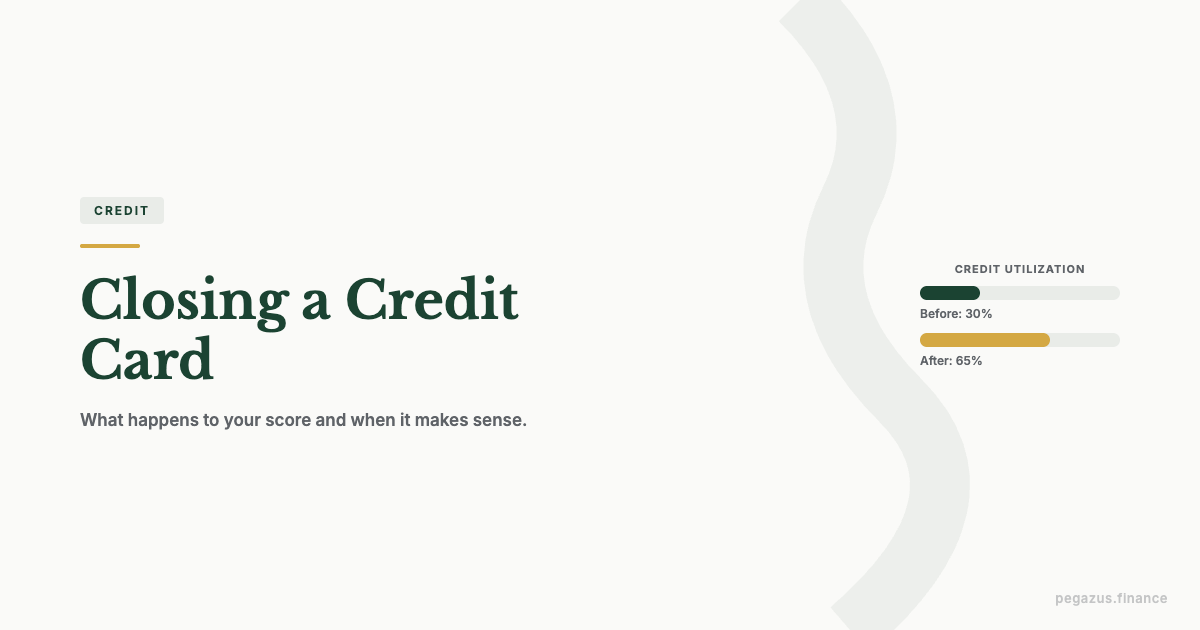
Three things shift the moment a card issuer marks an account as closed. First, your total available credit drops. If you carried a $10,000 limit on that card and your remaining cards total $15,000, you just lost 40% of your borrowing capacity. Second, the FICO scoring model recalculates your credit utilization ratio using only your open revolving accounts. A $3,000 balance across $25,000 in limits is 12% utilization. Remove that $10,000 card and the same $3,000 balance becomes 20% utilization.
Third, the account itself does not vanish. According to Experian, a closed account in good standing remains on your credit report for 10 years from the date it was closed. An account with negative history stays for seven years from the original delinquency date. Your average age of accounts will eventually drop when the closed account falls off, but that is years away.
How much will your credit score actually drop?
The size of the drop depends on your starting utilization and how much credit you lose. A person with low balances and several other cards might see a five to 10 point dip. Someone carrying balances near their limits on remaining cards could see a 30 to 50 point drop. The utilization component accounts for 30% of your FICO score, making it the second largest factor behind payment history at 35%.
Here is how closing a card changes utilization across different scenarios:
| Scenario | Total Limits Before | Total Balances | Utilization Before | Closed Card Limit | Utilization After |
|---|---|---|---|---|---|
| Low balances, many cards | $40,000 | $2,000 | 5% | $10,000 | 6.7% |
| Moderate balances | $25,000 | $5,000 | 20% | $10,000 | 33.3% |
| High balances, few cards | $15,000 | $6,000 | 40% | $5,000 | 60% |
| Near-maxed remaining cards | $20,000 | $9,000 | 45% | $8,000 | 75% |
The jump from 20% to 33% utilization crosses the threshold where most scoring models begin penalizing more aggressively. Keeping utilization below 30% is the most commonly cited benchmark, though data from FICO shows that the highest scorers typically use less than 10%.
When does closing a credit card make sense?
Closing a card is the right move when the annual fee exceeds the value you get from the card. If a card charges $95 per year and you no longer use the travel perks or rewards categories that justified it, the math is simple. Call the issuer first and ask for a product change to a no-fee card in the same family. This preserves the credit line and account age while eliminating the cost. Chase, American Express, and Citi all allow product changes on most cards.
The other valid reason is behavioral. If a specific card triggers overspending, closing it removes the temptation. Financial discipline matters more than a temporary score dip. A card sitting in a drawer still counts toward your available credit, but if you cannot trust yourself to leave it there, removing it is a net positive for your finances even if the score drops briefly.
When should you keep the card open instead?
Keep the card if it is your oldest account. Length of credit history makes up 15% of your FICO score, and your oldest card anchors the average. Keep it if the card has no annual fee. A no-fee card with a long history costs you nothing to maintain. Put a small recurring charge on it, set up autopay, and forget about it. This keeps the account active and prevents the issuer from closing it for inactivity.
Also keep the card if you are planning a major purchase. If you are applying for a mortgage or auto loan in the next six to 12 months, any score drop works against you. According to the Consumer Financial Protection Bureau, even small score differences can affect the interest rate you qualify for. A 20 point drop could move you from “excellent” to “very good” tier pricing, costing thousands over the life of a loan.
What is the safest way to close a card if you decide to do it?
Pay the balance to zero first. Redeem any remaining rewards points or cash back. Then call the number on the back of the card and request closure verbally. Follow up with a written request to the issuer’s address. Ask for written confirmation that the account was closed at your request with a zero balance. Check your credit report 30 to 60 days later through AnnualCreditReport.com to confirm it shows as “closed by consumer” rather than “closed by issuer.” The distinction matters because future lenders view issuer-initiated closures less favorably.
Before closing, consider paying down balances on your remaining cards. If you can get your total utilization below 10% across open accounts after the closure, the score impact will be minimal. This is the single most effective thing you can do to cushion the hit.
Frequently Asked Questions
Does closing a credit card remove it from your credit report?
No. A closed account in good standing stays on your report for 10 years. An account with late payments stays for seven years from the first missed payment.
Will my credit score recover after closing a card?
In most cases, yes. If your utilization stays below 30% and you continue making on-time payments, the score typically recovers within two to four months.
Is it better to downgrade a card instead of closing it?
Yes. A product change to a no-fee card preserves the credit line and account history while eliminating annual fees. This avoids any utilization or age impact.
Can the issuer close my card for inactivity?
Yes. Most issuers reserve the right to close accounts after 12 to 24 months of inactivity. A small recurring charge with autopay prevents this.
Sources
- myFICO — What’s in Your FICO Score
- Experian — How Long Does a Closed Account Stay on Your Credit Report
- CFPB — How Do I Get and Keep a Good Credit Score
- AnnualCreditReport.com — Free Credit Reports
Date checked: September 2026
This content is for informational purposes only and does not constitute financial advice. Read our full disclaimer and learn about how we research.