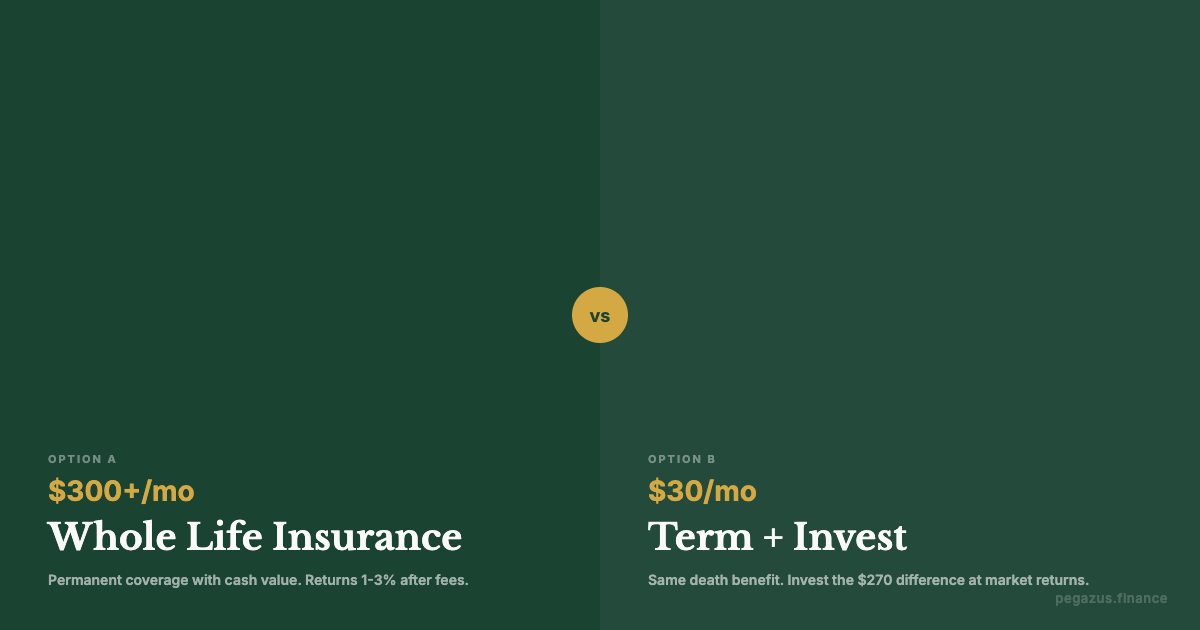
Whole life insurance is not worth it for most young adults. A 20-year term life policy with a $500,000 death benefit costs a healthy 30-year-old roughly $25 to $35 per month. An equivalent whole life policy costs $300 to $500 per month. The cash value component of whole life grows at 1 to 3% after fees, far below what you would earn investing the difference in a low-cost index fund.
What is the difference between term life and whole life insurance?
Term life insurance covers you for a set period, typically 10, 20, or 30 years. If you die during the term, your beneficiaries receive the death benefit. If you outlive the term, the policy expires with no payout and no cash value. It is pure insurance. Whole life insurance covers you for your entire life as long as you pay premiums. Part of each premium goes toward the death benefit, and part builds a “cash value” account that grows at a guaranteed rate set by the insurer.
The price difference is substantial. According to rate data from Policygenius, a healthy 30-year-old non-smoker pays roughly $25 to $35 per month for a 20-year term policy with a $500,000 death benefit. The same person pays $300 to $500 per month for a whole life policy with the same death benefit. That is a 10 to 15 times cost difference for the same amount of coverage.
How does the cash value in whole life actually perform?
Insurance companies market whole life as a savings vehicle, but the returns are underwhelming. The guaranteed growth rate on cash value typically runs between 1 and 3% annually after the insurer’s fees and the cost of insurance are deducted. The first several years of premiums go almost entirely toward fees and commissions. Most whole life policies do not break even on cash value for 10 to 15 years.
Compare that to investing the premium difference. If you buy a $30 per month term policy instead of a $400 per month whole life policy, you free up $370 per month. Invested in a total stock market index fund like Vanguard’s VTI with a historical average return of roughly 10% nominal, that $370 per month grows to approximately $280,000 over 20 years and $760,000 over 30 years. The whole life cash value after 20 years would be roughly $80,000 to $120,000. The math is not close.
Here is a direct comparison over 20 and 30 years:
| Metric | Term + Invest Difference | Whole Life |
|---|---|---|
| Monthly cost | $30 (term) + $370 (invested) | $400 (all-in) |
| Death benefit | $500,000 (during term) | $500,000 (lifetime) |
| Investment value at 20 years | ~$280,000 | ~$100,000 (cash value) |
| Investment value at 30 years | ~$760,000 | ~$200,000 (cash value) |
| Access to funds | Sell investments anytime | Borrow against cash value (with interest) |
| Tax treatment | Capital gains on investments | Tax-deferred growth, tax-free loans |
The opinion I will defend: for a young adult earning under $200,000 with no estate planning needs, buying term and investing the difference is the better strategy in almost every scenario. Whole life insurance is a product designed to benefit the agent who sells it, not the buyer.
When does whole life insurance actually make sense?
Whole life has a narrow but real use case for high-net-worth individuals. If your estate exceeds the federal estate tax exemption, which the IRS sets at $13.99 million per individual when I last checked, an irrevocable life insurance trust (ILIT) funded with whole life can pay the estate tax without forcing your heirs to sell assets. This is a sophisticated estate planning tool that requires an attorney and a financial advisor to implement correctly.
Whole life also has a niche role for parents of children with special needs who will require lifelong care and cannot manage an inheritance. A special needs trust funded by whole life ensures the child receives support without disqualifying them from Medicaid or SSI benefits. Outside of these specific situations, term life is the correct choice for young adults.
How much term life insurance do young adults need?
The standard formula is 10 to 12 times your annual income, adjusted for debts and dependents. A single person with no dependents may need only enough to cover final expenses and outstanding debts, perhaps $100,000 to $250,000. A parent with a mortgage, young children, and a non-working spouse needs significantly more. The CFPB recommends factoring in mortgage balance, years of income replacement, childcare costs, and education funding.
Buy term life when you are young and healthy. Premiums lock in based on your age and health at the time of application. A 25-year-old gets dramatically better rates than a 40-year-old for the same coverage. A 30-year term purchased at 25 covers you until 55, by which point your mortgage should be paid down, your children should be financially independent, and your investments should be substantial enough that you self-insure.
Frequently Asked Questions
Can you cash out a whole life insurance policy?
Yes. You can surrender the policy for its cash value, but you will owe income tax on gains above your total premiums paid. Surrender charges in the first 10 to 15 years reduce what you receive.
What happens if you outlive your term life policy?
The policy expires and you receive nothing. Some term policies offer a conversion option to whole life without a medical exam, but at a higher premium.
Is whole life insurance a good retirement savings tool?
No. The returns are lower than a Roth IRA or 401(k) invested in index funds. Max out tax-advantaged retirement accounts before considering whole life for savings.
Do you need life insurance if you have no dependents?
Usually no. A small policy to cover funeral costs and outstanding debts may be sufficient. Read our guide on life insurance for single adults for specifics.
Sources
- Policygenius — Term vs. Whole Life Insurance
- IRS — Estate Tax
- CFPB — How Much Life Insurance Do I Need
- Special Needs Alliance — Life Insurance Trusts
Date checked: September 2026
This content is for informational purposes only and does not constitute financial or insurance advice. Read our full disclaimer and learn about how we research.