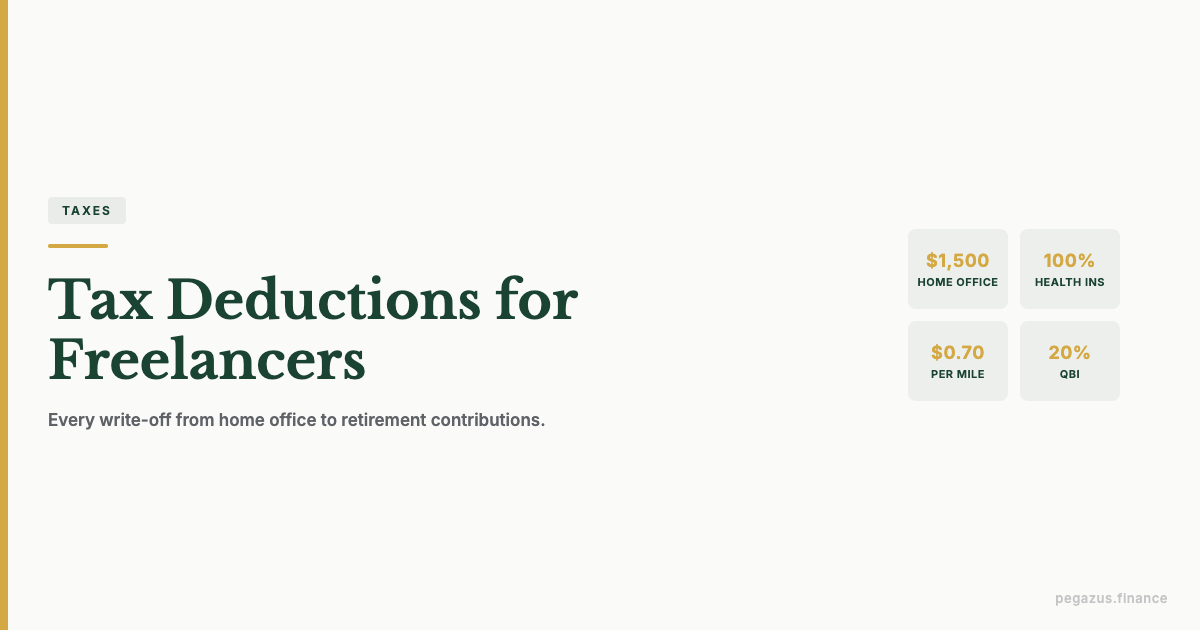
Freelancers and self-employed workers can deduct business expenses including the home office ($5 per square foot, up to $1,500 simplified), health insurance premiums (100% deductible), retirement contributions (SEP-IRA up to 25% of net income), vehicle use ($0.70 per mile), and the 20% qualified business income deduction under Section 199A. These deductions apply on top of the standard deduction and directly reduce both income tax and self-employment tax liability.
What is the home office deduction and who qualifies?
The home office deduction allows you to write off a portion of your housing costs if you use part of your home regularly and exclusively for business. The IRS offers two methods. The simplified method lets you deduct $5 per square foot of dedicated office space, up to 300 square feet, for a maximum deduction of $1,500. The regular method requires calculating the actual percentage of your home used for business and applying it to rent, mortgage interest, utilities, insurance, and repairs.
According to IRS Publication 587, the space must be your principal place of business or a place where you regularly meet clients. A kitchen table you also eat dinner at does not qualify. A dedicated desk in a spare bedroom does. The simplified method saves time and avoids depreciation recapture. For most first-time freelancers, it is the better choice unless your actual housing costs are very high relative to your income.
Can you deduct health insurance premiums as a freelancer?
Yes. Self-employed individuals can deduct 100% of health insurance premiums for themselves, their spouse, and dependents. This is an above-the-line deduction on Schedule 1 of Form 1040, meaning it reduces your adjusted gross income even if you take the standard deduction. The deduction covers medical, dental, and qualifying long-term care insurance premiums.
The IRS states the deduction cannot exceed your net self-employment income. If your business earned $40,000 and your annual premiums total $12,000, you deduct the full $12,000. If your premiums exceed your business income, the excess is not deductible through this provision (though it may be itemizable as a medical expense if total medical costs exceed 7.5% of AGI). This single deduction saves most freelancers $2,000 to $5,000 per year in taxes depending on their bracket.
What retirement accounts offer the biggest deductions for self-employed workers?
Three retirement vehicles stand out for the self-employed, and the contribution limits are significantly higher than a traditional IRA. When I last checked, the limits were as follows:
| Account Type | Contribution Limit | Best For | Admin Complexity |
|---|---|---|---|
| SEP-IRA | 25% of net SE income, up to $70,000 | Solo freelancers, simple setup | Low |
| Solo 401(k) | $23,500 employee + 25% employer, up to $70,000 total | Higher earners wanting max deferral | Medium |
| SIMPLE IRA | $16,500 employee + 3% match | Small businesses with employees | Low |
| Traditional IRA | $7,000 ($8,000 if 50+) | Supplement to above | Low |
The Solo 401(k) is the most powerful option for freelancers earning $60,000 or more because it allows both employee and employer contributions. A freelancer with $100,000 in net self-employment income could contribute $23,500 as the employee plus roughly $18,587 as the employer (20% of net SE income after the SE tax deduction), sheltering over $42,000 from taxes. The IRS guidelines for one-participant plans explain the full calculation.
Which vehicle and travel expenses can you write off?
If you use your car for business, you can deduct either the standard mileage rate or actual expenses, but you must choose one method in the first year you use the vehicle for business. The IRS standard mileage rate was $0.70 per mile for business use when I last checked. Actual expenses include gas, insurance, repairs, depreciation, and lease payments, prorated by the percentage of business miles driven.
Keep a mileage log. The IRS requires contemporaneous records showing the date, destination, business purpose, and miles driven for each trip. Apps like MileIQ and Everlance automate this. Commuting from home to a regular office does not count, but driving from your home office to a client meeting does. For most freelancers driving under 15,000 business miles per year, the standard mileage rate produces a larger deduction than actual expenses. Above that threshold, run both calculations and take the higher one.
What is the qualified business income deduction under Section 199A?
The QBI deduction allows eligible self-employed workers and pass-through business owners to deduct up to 20% of their qualified business income from their taxable income. For a freelancer with $80,000 in net business income, that is a $16,000 deduction, saving roughly $3,520 in a 22% tax bracket. The deduction is available regardless of whether you itemize or take the standard deduction.
Income limits apply for specified service trades (law, health, consulting, accounting, financial services). When I last checked, the phase-out began at $191,950 for single filers. Below that threshold, you get the full 20% deduction regardless of your profession. Above it, the deduction phases out for service businesses. The IRS QBI page outlines the full calculation. This deduction is one of the most valuable and most overlooked benefits of self-employment, and it applies to quarterly tax estimates as well.
What other common deductions do freelancers miss?
Beyond the major categories, several smaller deductions add up. Business software subscriptions (Adobe, project management tools, accounting software), professional development (courses, certifications, conferences), business insurance, bank fees on business accounts, and professional services (accountant fees, legal consultations) are all deductible. Internet and phone bills can be partially deducted based on business use percentage. If 40% of your internet usage is for work, deduct 40% of the bill.
The self-employment tax deduction is also frequently missed. You pay 15.3% in self-employment tax (12.4% Social Security plus 2.9% Medicare), but you can deduct the employer-equivalent half (7.65%) from your adjusted gross income. On $80,000 of net self-employment income, that is a $6,120 deduction you get automatically on Schedule SE. The budgeting framework should account for these quarterly tax obligations from the start.
Frequently Asked Questions
Do I need an LLC to claim self-employment tax deductions?
No. Sole proprietors file Schedule C and claim the same deductions. An LLC provides liability protection but does not change your tax deductions. The IRS treats single-member LLCs as sole proprietorships for tax purposes unless you elect S-corp or C-corp treatment.
Can I deduct meals with clients?
Business meals with clients or prospects where you discuss business are 50% deductible. Keep the receipt and note who attended, the business purpose, and the date. Solo meals while working are generally not deductible unless you are traveling overnight for business.
What happens if I miss a quarterly estimated payment?
The IRS charges an underpayment penalty if you owe more than $1,000 at filing time and did not pay at least 90% of current year taxes or 100% of prior year taxes through estimates. The penalty rate fluctuates with the federal short-term rate and was around 7-8% when I last checked.
Should I hire an accountant or use tax software?
If your freelance income is under $75,000 with straightforward deductions, tax software like TurboTax Self-Employed or FreeTaxUSA handles it well. Above that, or if you have complex situations like multiple business entities or international income, a CPA typically saves more in found deductions than their fee costs.
Sources
- IRS Publication 587, “Business Use of Your Home.” Date checked: September 2026.
- IRS Topic No. 502, “Medical and Dental Expenses.” Date checked: September 2026.
- IRS, “One-Participant 401(k) Plans.” Date checked: September 2026.
- IRS, “Qualified Business Income Deduction” (Section 199A). Date checked: September 2026.
- IRS, “Standard Mileage Rates.” Date checked: September 2026.