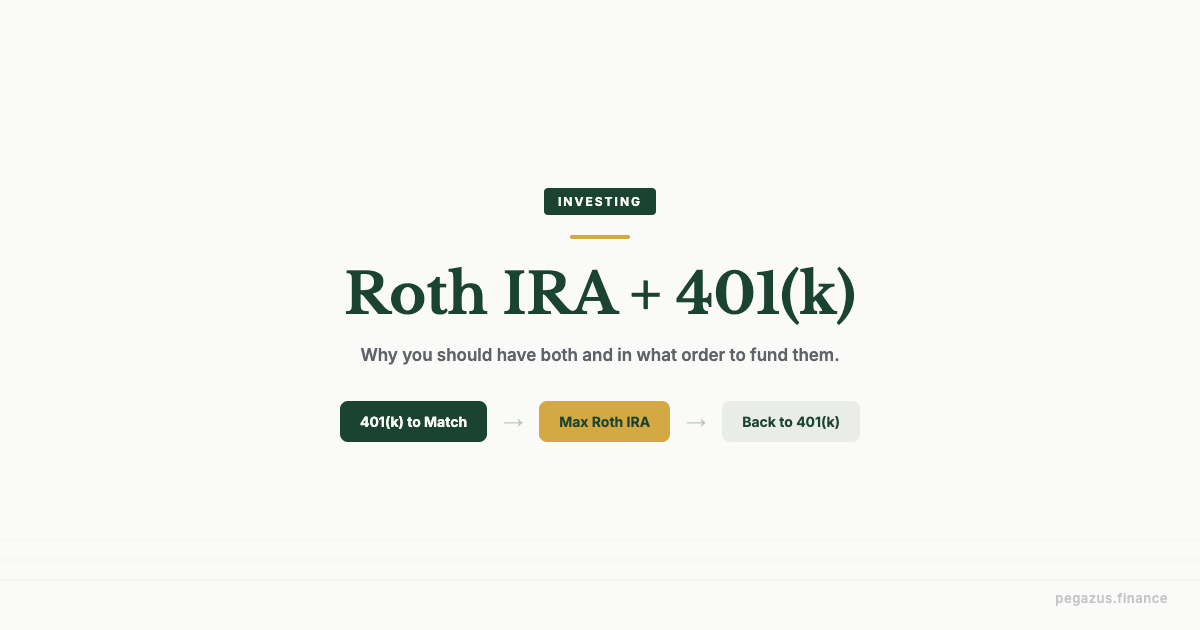
Yes, opening a Roth IRA alongside a 401(k) is one of the best moves in personal finance. The optimal sequence is: contribute to your 401(k) up to the employer match, then max out a Roth IRA ($7,000 limit, or $8,000 if 50 or older), then return to the 401(k) for additional contributions. This strategy captures free employer money, builds tax diversification, and gives you a tax-free income stream in retirement that is not subject to required minimum distributions.
Why should you have both a 401(k) and a Roth IRA?
A 401(k) and a Roth IRA serve different tax purposes. Traditional 401(k) contributions reduce your taxable income today but are taxed as ordinary income in retirement. Roth IRA contributions are made with after-tax dollars but grow and are withdrawn completely tax-free. Having both means you control your tax bill in retirement by choosing which account to draw from based on your tax situation that year.
This is called tax diversification, and the IRS rules allow you to contribute to both simultaneously with no conflict. If your employer matches 401(k) contributions, that match is free money with an immediate 50% to 100% return. No investment can compete with that. But once you capture the match, the Roth IRA offers advantages the 401(k) cannot: better fund selection, no required minimum distributions, and penalty-free withdrawal of contributions at any time. The full comparison breaks down when each account wins.
What is the optimal contribution sequence?
Financial planners at Vanguard and Fidelity recommend the same three-step order. First, contribute to your 401(k) up to the full employer match. If your employer matches 50% of contributions up to 6% of salary, contribute 6% to capture the full match. Second, open and max out a Roth IRA. When I last checked, the annual limit was $7,000 ($8,000 if you are 50 or older). Third, return to your 401(k) and increase contributions toward the annual maximum of $23,500.
This sequence works because the match has the highest guaranteed return, the Roth IRA has the best tax treatment and flexibility, and the 401(k) offers the highest contribution ceiling. A worker earning $75,000 following this order might contribute $4,500 to the 401(k) (6% for the match), $7,000 to the Roth IRA, and another $12,000 to the 401(k), for $23,500 total retirement savings, roughly 31% of income.
| Income Level | Step 1: 401(k) to Match | Step 2: Max Roth IRA | Step 3: Back to 401(k) | Total Saved | Tax Savings Today |
|---|---|---|---|---|---|
| $50,000 | $3,000 (6%) | $7,000 | $2,000 | $12,000 | ~$1,100 (22% bracket) |
| $75,000 | $4,500 (6%) | $7,000 | $12,000 | $23,500 | ~$3,630 (22% bracket) |
| $100,000 | $6,000 (6%) | $7,000 | $10,500 | $23,500 | ~$3,630 (22% bracket) |
| $130,000 | $7,800 (6%) | $7,000 | $8,700 | $23,500 | ~$5,640 (24% bracket) |
What are the income limits for Roth IRA contributions?
The IRS sets income limits for direct Roth IRA contributions that change annually. When I last checked, single filers could contribute the full amount with a modified adjusted gross income (MAGI) under $150,000. Contributions phase out between $150,000 and $165,000 and are not allowed above $165,000. For married couples filing jointly, the phase-out range was $236,000 to $246,000.
If your income exceeds these limits, the backdoor Roth IRA strategy remains available. You contribute to a traditional IRA (no income limit for non-deductible contributions) and then convert to a Roth IRA. The IRS permits this conversion regardless of income. The key complication is the pro-rata rule: if you have existing pre-tax IRA balances, a portion of your conversion will be taxable. The cleanest approach is to roll any existing traditional IRA balances into your 401(k) before doing the backdoor conversion, leaving only the non-deductible contribution to convert tax-free.
What are the unique advantages of a Roth IRA over a 401(k)?
Three advantages make the Roth IRA worth prioritizing after capturing the match. First, no required minimum distributions. A traditional 401(k) forces you to start withdrawing at age 73, generating taxable income whether you need it or not. A Roth IRA has no RMDs during your lifetime, letting the account grow tax-free for decades longer. Second, you can withdraw your contributions (not earnings) at any time without penalty or taxes. This makes the Roth IRA a partial emergency backstop.
Third, investment selection. Most 401(k) plans offer 15 to 30 fund options chosen by your employer, and some include high-fee funds. A Roth IRA at Fidelity, Schwab, or Vanguard gives you access to thousands of low-cost index funds and ETFs. You can build a simple three-fund portfolio (total US stock, international stock, bonds) with expense ratios under 0.10%. The 401(k) analysis covers situations where the 401(k) is less attractive.
When does it not make sense to fund a Roth IRA?
There are two scenarios where skipping the Roth IRA in favor of more 401(k) contributions makes sense. First, if you are in a high tax bracket now (32% or above) and expect to be in a significantly lower bracket in retirement. The traditional 401(k) deduction saves you 32 cents per dollar today, while the Roth benefit of tax-free withdrawals is worth less if your retirement bracket is 12% or 22%. Second, if your employer offers a Roth 401(k) option with a good match, you can get Roth treatment with the higher $23,500 contribution limit.
For most workers in the 12% to 24% brackets, the Roth IRA is the clear winner after the match. Your current tax rate is historically low, and the odds of rates being higher in 20 to 30 years are significant given current federal debt levels. Locking in tax-free growth now, while rates are comparatively low, is the financially conservative choice. The Social Security Trustees Report projects funding shortfalls that historically lead to revenue increases, reinforcing the case for Roth savings.
Frequently Asked Questions
Can I contribute to a 401(k) and Roth IRA in the same year?
Yes. The contribution limits are separate. You can contribute up to $23,500 to a 401(k) and up to $7,000 to a Roth IRA in the same tax year, assuming you meet the Roth income requirements. These limits apply per person, so a married couple can double these amounts.
What if my employer does not offer a 401(k)?
Max the Roth IRA first ($7,000), then consider a SEP-IRA or Solo 401(k) if you have self-employment income. If you are a W-2 employee with no workplace plan, the Roth IRA is your primary retirement vehicle and the annual limit is more binding.
Should I do a Roth 401(k) instead of a traditional 401(k) plus Roth IRA?
If your plan offers a Roth 401(k) with a good fund lineup, it simplifies the strategy. But you lose the investment flexibility of a separate Roth IRA. Many planners recommend the traditional 401(k) to match plus separate Roth IRA for the best of both worlds.
How do I open a Roth IRA?
Open one online at Fidelity, Schwab, or Vanguard in under 15 minutes. You need your Social Security number, bank routing number, and employment information. There is no minimum to open the account at Fidelity or Schwab. Fund it with automatic monthly transfers aligned to your pay schedule.
Sources
- IRS, “Roth IRAs” and annual contribution limits. Date checked: September 2026.
- IRS, “Amount of Roth IRA Contributions That You Can Make.” Date checked: September 2026.
- Social Security Administration, OASDI Trustees Report. Date checked: September 2026.
- Vanguard, “How America Saves” annual report. Date checked: September 2026.