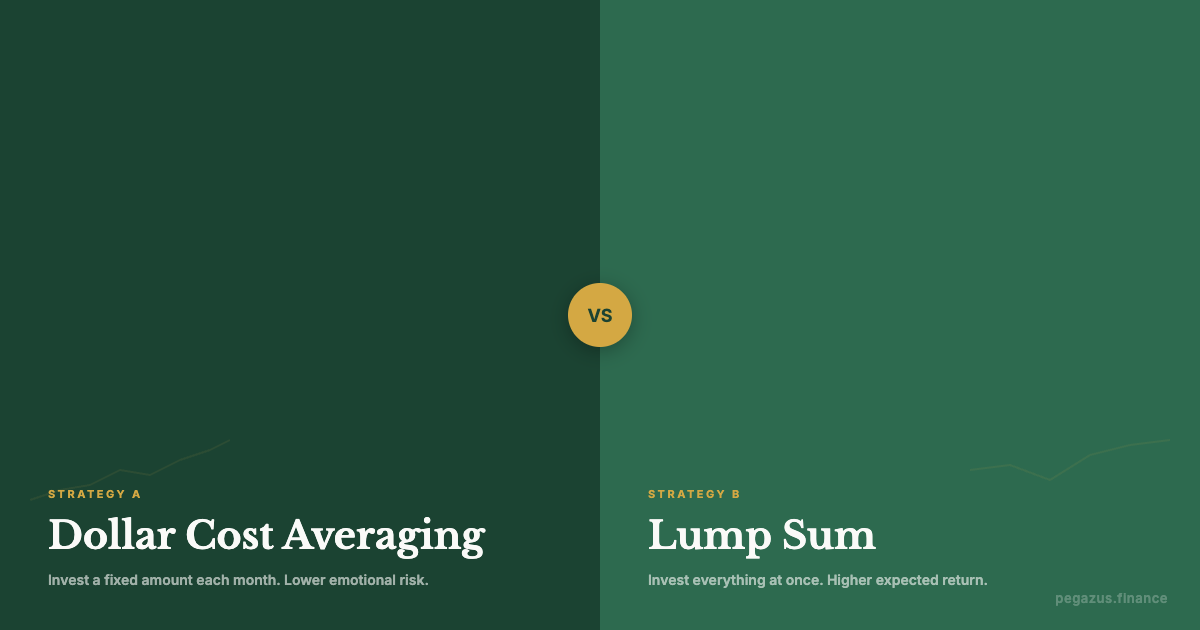
Lump sum investing beats dollar cost averaging about two-thirds of the time because markets trend upward and money in the market longer earns more. But dollar cost averaging is still the right choice for most people. It cuts your maximum drawdown roughly in half and prevents the emotional disaster of investing a lump sum right before a crash. If you receive a windfall, invest half immediately and DCA the rest over six months.
What is dollar cost averaging and how does it work?
Dollar cost averaging means investing a fixed dollar amount at regular intervals regardless of price. If you invest $500 on the first of every month into an S&P 500 index fund, you buy more shares when prices are low and fewer when prices are high. Over time, your average cost per share falls below the average price per share.
The Vanguard Group published research showing that DCA reduces portfolio volatility during the accumulation phase by approximately 30% compared to a single entry point. This matters because most investors underperform not due to bad fund selection but due to behavioral errors. They panic-sell after a drop or delay investing while waiting for the “right time.” DCA removes both decisions. Your beginner investing guide covers how to set up automatic contributions, which is DCA in practice.
Does lump sum investing actually beat dollar cost averaging?
Yes, in most historical periods. Vanguard’s landmark study analyzed rolling 12-month periods across U.S., U.K., and Australian markets from 1926 through 2021. Lump sum investing outperformed DCA approximately 67% of the time in the U.S., with an average outperformance of 2.39 percentage points over 12 months.
The math is straightforward. Markets rise more often than they fall. When you invest a lump sum immediately, you capture more of that upward drift. When you DCA, each uninvested portion sits in cash earning less than equities would have returned. However, that 67% figure means DCA still wins a full third of the time, and those tend to be the periods that matter most emotionally. The table below shows how both approaches performed across recent market conditions.
| Scenario | $12,000 lump sum Jan 1 | $1,000/month DCA | Winner |
|---|---|---|---|
| Strong bull (S&P 500 +25%) | $15,000 | $14,200 | Lump sum by $800 |
| Moderate growth (+12%) | $13,440 | $13,080 | Lump sum by $360 |
| Flat market (+2%) | $12,240 | $12,180 | Near tie |
| Correction (-15%) | $10,200 | $10,950 | DCA by $750 |
| Bear market (-30%) | $8,400 | $9,600 | DCA by $1,200 |
Figures are simplified illustrations based on linear price movement. Actual returns depend on the sequence of monthly prices. Source: calculations using S&P 500 historical return patterns from S&P Dow Jones Indices.
When is dollar cost averaging the smarter choice?
DCA is the better strategy when your primary risk is behavioral, not mathematical. If investing a $50,000 inheritance all at once would keep you awake at night watching the market, DCA protects you from yourself. The 2.39 percentage points you might sacrifice are a small insurance premium against panic-selling at a loss.
DCA also wins in specific situations: when you expect increased volatility (election years, rate-change cycles), when the amount represents a large share of your net worth (over 25%), or when you are new to investing and building confidence. The SEC’s guide to investing emphasizes that the most important factor is investing consistently over time, not timing any single entry point. If you are already investing monthly from your paycheck into a 401(k) or Roth IRA, you are already dollar cost averaging.
What is the best approach for a windfall or lump sum?
Split the difference. Invest half immediately to capture the statistical edge of lump sum investing, then DCA the remaining half over three to six months to manage downside risk. This hybrid approach captures roughly 80% of the lump sum advantage while cutting the maximum potential regret in half.
Research from Morningstar supports this compromise. Their analysis found that a 50/50 split approach landed within 0.5 percentage points of full lump sum performance in most historical periods while dramatically reducing the worst-case scenario. The key variable is how long you stretch the DCA portion. Longer than 12 months and the cash drag becomes significant. Shorter than 3 months and you barely reduce volatility exposure. Six months is the sweet spot for most investors.
Does dollar cost averaging work with index funds and ETFs?
DCA works with any investment, but it pairs especially well with broad-market index funds and ETFs because they are diversified and low-cost. When you DCA into a single stock, you are averaging into company-specific risk. When you DCA into a total stock market fund like VTI or FXAIX, you are averaging into the entire economy’s trajectory.
Most brokerages now support automatic investing at zero commission. Fidelity, Schwab, and Vanguard all allow you to set a recurring purchase of index funds or ETFs on any schedule. Fidelity and Schwab also support fractional shares, so your full $500 (or $100, or any amount) gets invested without rounding to whole shares. Set it, forget it, and check quarterly. That is the entire DCA strategy for someone investing $100 a month or more.
Frequently Asked Questions
Is dollar cost averaging just for beginners?
No. DCA is a risk management strategy used at every level. Institutional investors deploy capital over weeks or months to avoid moving the market. For individuals, it serves the same purpose: managing entry-point risk and behavioral risk regardless of experience.
How often should I invest when dollar cost averaging?
Monthly is the most common and practical frequency. Weekly investing performs nearly identically over long periods but adds complexity. Align your investment schedule with your paycheck for the least friction.
Does DCA work in a declining market?
DCA shines in declining markets because you buy more shares at lower prices, reducing your average cost. When the market recovers, your position is worth more than if you had invested the lump sum at the higher pre-decline price.
Should I DCA into bonds too?
If you are building a bond allocation, lump sum is generally better because bond returns are more predictable and the DCA advantage in volatile periods is smaller. Reserve DCA for equity allocations where volatility is higher.
Sources
- Vanguard Research, “Dollar-Cost Averaging Just Means Taking Risk Later,” investor.vanguard.com. Date checked: August 2026.
- S&P Dow Jones Indices, historical return data, spglobal.com. Date checked: August 2026.
- SEC, “Saving and Investing: A Roadmap to Your Financial Security,” sec.gov. Date checked: August 2026.
- Morningstar, “Lump Sum vs. Dollar Cost Averaging,” morningstar.com. Date checked: August 2026.
Pegazus Finance is not a financial advisor. Content is informational only. See our methodology and disclaimer.