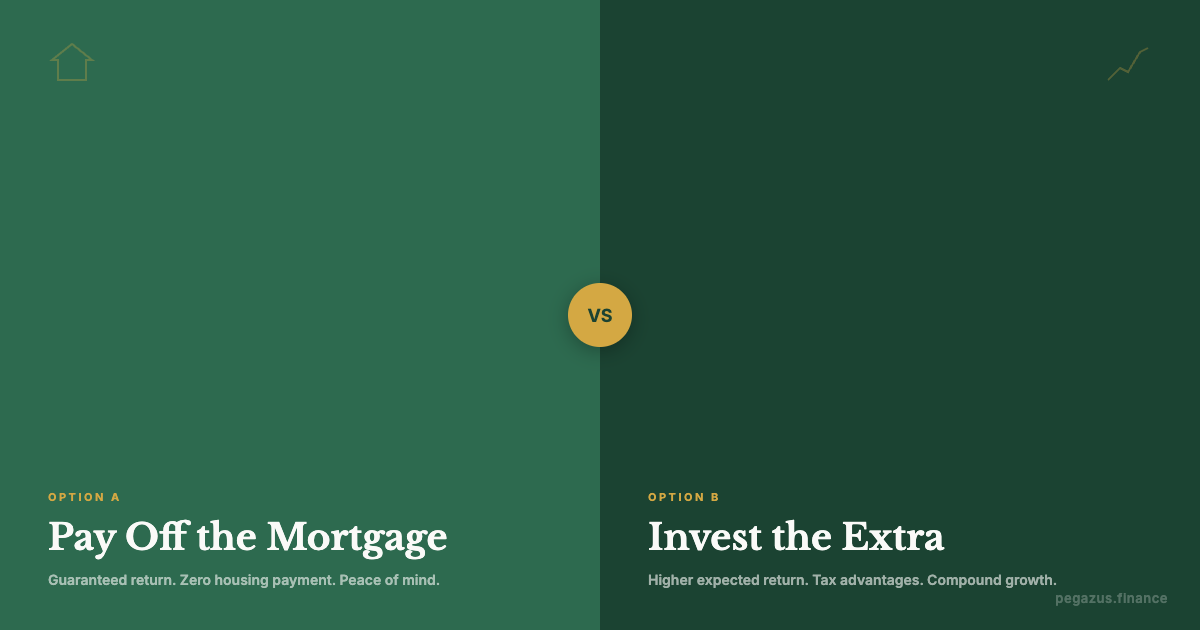
If your mortgage interest rate is below 5%, investing the extra money in a low-cost index fund is likely to build more wealth over time. The S&P 500 has returned roughly 10% annually on average over the past several decades. But if your rate is above 6% or you value the certainty of being debt-free, paying off the mortgage early is a guaranteed return at your interest rate with zero market risk.
What is the real math behind this decision?
The core comparison is your mortgage interest rate versus your expected investment return. Paying off a 6.5% mortgage is equivalent to earning a guaranteed 6.5% return on your money. Investing in an S&P 500 index fund has historically averaged roughly 10% nominal returns, but those returns vary wildly year to year and are never guaranteed.
The after-tax picture matters. Mortgage interest is only deductible if you itemize deductions, and the standard deduction is $15,000 for single filers and $30,000 for married couples filing jointly when I last checked. Most homeowners with a mortgage under $375,000 will not itemize because their mortgage interest plus other deductions falls below the standard deduction threshold. If you do not itemize, your mortgage rate is your true cost with no tax benefit. Investment gains in a taxable brokerage account face capital gains tax of 0%, 15%, or 20% depending on income. Inside a Roth IRA, gains are tax-free. This tax treatment makes the comparison more favorable for investing when done through retirement accounts.
| Scenario | $500/mo Extra to Mortgage (5.5%, 25 yrs left) | $500/mo Invested (8% avg return) | Difference |
|---|---|---|---|
| After 10 years | $67,800 equity gained + $18,400 interest saved | $91,473 portfolio value | Investing ahead by ~$5,300 |
| After 15 years | Mortgage paid off, $109,200 interest saved total | $173,838 portfolio value | Investing ahead by ~$64,600 |
| After 20 years | $109,200 saved, then invest $500/mo for 5 yrs = $36,738 | $294,510 portfolio value | Investing ahead by ~$148,500 |
When does paying off the mortgage win?
Paying off the mortgage is the better choice when your interest rate exceeds 6%, when you are within 5 to 7 years of payoff, when you have already maximized tax-advantaged retirement accounts, or when the psychological value of being debt-free is worth more to you than the mathematical difference.
A guaranteed return matters more as you approach retirement. If you are 55 and plan to retire at 62, eliminating your mortgage payment reduces your required retirement income by that monthly amount. That is more valuable than a slightly higher expected return from stocks you might need to sell during a downturn. The Federal Reserve’s Survey of Consumer Finances shows that households approaching retirement with no mortgage have significantly higher net worth confidence. Risk tolerance also matters here. If a 20% market drop would cause you to panic-sell investments, the volatile higher return is theoretical. The guaranteed mortgage payoff return is real regardless of what markets do.
When does investing the extra money win?
Investing wins when your mortgage rate is below 5%, when you have decades until retirement, when you use tax-advantaged accounts that shelter gains, and when you can tolerate market volatility without selling during downturns. The longer your time horizon, the more likely stocks outperform your mortgage rate.
If you have not yet maximized your retirement contributions, that comes first before either option. A 401(k) with an employer match is free money. A Roth IRA offers tax-free growth. Both beat paying down a low-rate mortgage. According to data from S&P Dow Jones Indices, the S&P 500 has delivered positive returns over every 20-year rolling period in its history. Over shorter periods, losses happen regularly. This is why the decision depends on your timeline. The opportunity cost of prepaying a 3.5% mortgage locked in years ago while earning 4.75% in a high-yield savings account is obvious. You lose money by prepaying.
Can you split the extra money between both goals?
Yes, and this is my recommended approach for most people who cannot decide. Allocate 60% of extra cash to investments and 40% to additional mortgage principal. You capture most of the market upside while still accelerating your payoff timeline. Adjust the ratio based on your mortgage rate.
With a $500 monthly surplus, put $300 into a Roth IRA or taxable brokerage account and $200 toward extra mortgage principal. The extra $200 on a $300,000 mortgage at 6% shaves roughly 4 years off a 30-year term and saves over $50,000 in interest. Meanwhile, $300 per month invested at 8% grows to approximately $88,000 in 15 years. You get both the guaranteed debt reduction and the growth potential. Rebalance annually. If your mortgage rate drops through refinancing, shift more toward investing. If markets crash and you feel anxious, shift more toward the mortgage for a year. The split approach removes the all-or-nothing pressure that keeps many people from doing either effectively.
What role does your emergency fund play in this decision?
Never accelerate mortgage payments or invest aggressively until you have three to six months of expenses in liquid savings. A fully funded emergency fund prevents you from needing to sell investments at a loss or take on high-interest debt during a job loss or medical emergency.
Your emergency fund earns 4.50% to 5.00% in a high-yield savings account when I last checked. That is close to many current mortgage rates, meaning your emergency fund is already working almost as hard as a mortgage prepayment. Once your emergency fund is solid, direct extra cash toward whichever strategy you have chosen. Some financial planners recommend keeping a larger emergency fund (six to nine months) before aggressively investing, especially if you are self-employed or in a volatile industry. The sequence matters: emergency fund first, employer match second, high-interest debt third, then choose between extra mortgage payments and additional investing.
Frequently Asked Questions
Should I refinance my mortgage before deciding?
If your current rate is above 7% and rates have dropped, refinancing could lower your rate enough to make investing the better option. Calculate whether the closing costs (typically 2% to 5% of the loan balance) are recovered within three years through lower payments.
Does this advice change if I have a 15-year mortgage?
A 15-year mortgage already has aggressive principal paydown built in. Extra payments reduce the term modestly. Investing the surplus is usually more impactful because you are already on an accelerated payoff schedule.
What about using a HELOC to invest?
Borrowing against your home to invest in the stock market adds leverage risk. If investments decline and your home value drops simultaneously, you face losses on both sides. Most financial planners advise against this strategy for individual investors.
Is paying off the mortgage a good strategy right before retirement?
Yes. Eliminating your largest monthly expense before your income drops reduces the withdrawal rate needed from retirement accounts. A paid-off home is the single most impactful expense reduction for retirees, according to the Federal Reserve Survey of Consumer Finances.
Sources
- Federal Reserve, “Survey of Consumer Finances,” federalreserve.gov. Date checked: Sep 2026.
- S&P Dow Jones Indices, “S&P 500 Historical Returns,” spglobal.com. Date checked: Sep 2026.
- IRS, “Standard Deduction Amounts,” irs.gov. Date checked: Sep 2026.
- Consumer Financial Protection Bureau, “Mortgage Key Terms,” consumerfinance.gov. Date checked: Sep 2026.
This article is for informational purposes only and does not constitute financial advice. Read our full disclaimer and research methodology.