Index Funds vs. ETFs for Beginners: Which Should You Pick?
Nathan Cross||5 min read|Last reviewed September 1, 2026
For most beginners, ETFs are the better choice. They have no minimum investment, charge lower expense ratios, and trade through any brokerage account. Index mutual funds make sense only if you want automatic recurring investments and your broker does not offer fractional ETF shares. Both track the same indexes and deliver nearly identical long-term returns. Pick whichever lets you invest consistently without friction.
What is the actual difference between an index fund and an ETF?
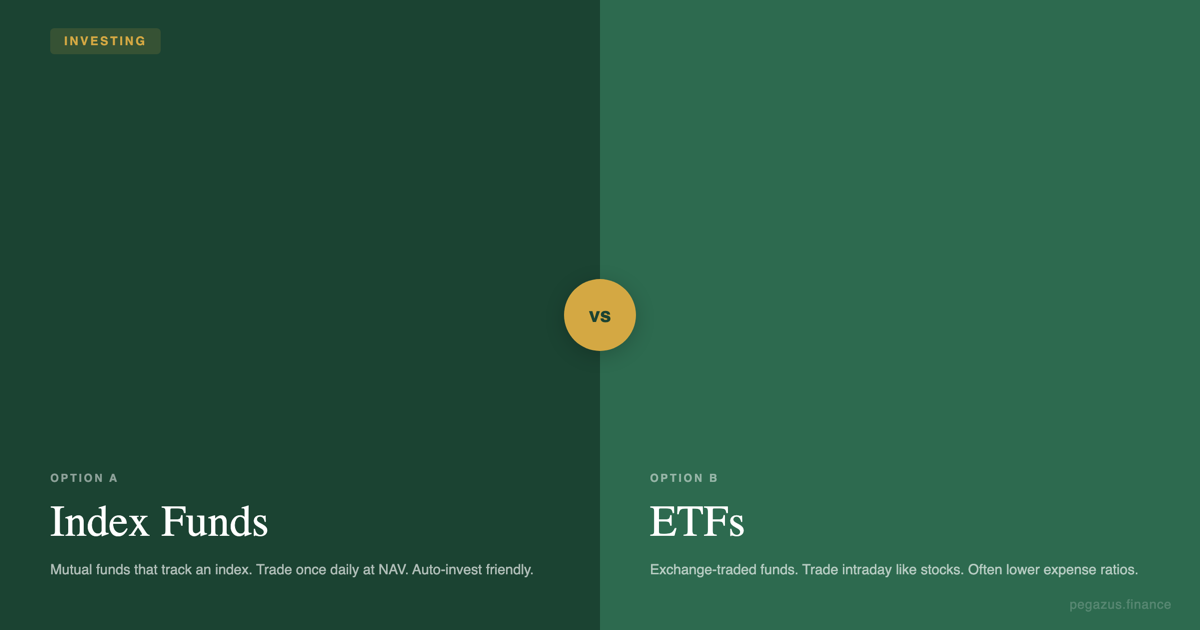
An index fund is a mutual fund that tracks a market index like the S&P 500. An ETF (exchange-traded fund) does the same thing but trades on a stock exchange like an individual share. Both hold the same underlying stocks or bonds. Both aim to match, not beat, an index.
The structural difference matters at the edges. Index mutual funds price once per day at 4:00 PM Eastern, at the net asset value (NAV). ETFs price continuously during market hours, so you see real-time quotes. Mutual funds require you to place an order before the market closes; the actual execution price is unknown until after settlement. ETFs let you set a limit order at a specific price, giving you more control over what you pay.
For a long-term investor buying and holding, the daily pricing difference is irrelevant. You are not day-trading an S&P 500 index fund. The only time intraday pricing helps a beginner is during extreme volatility, and even then the correct move is usually to do nothing.
Which costs less to own over time?
ETFs typically win on expense ratios by a small margin. The ongoing cost difference between the two formats has narrowed to almost nothing at the largest providers, but the gap still exists.
Fund
Format
Expense Ratio
Minimum Investment
Provider
VTI
ETF
0.03%
Price of 1 share (or fractional)
Vanguard
VTSAX
Mutual Fund
0.04%
$3,000
Vanguard
FSKAX
Mutual Fund
0.015%
$0
Fidelity
ITOT
ETF
0.03%
Price of 1 share (or fractional)
iShares (BlackRock)
SWTSX
Mutual Fund
0.03%
$0
Schwab
SCHB
ETF
0.03%
Price of 1 share (or fractional)
Schwab
Fidelity’s FSKAX charges 0.015%, which is lower than any ETF equivalent. This is a deliberate loss-leader. Schwab matches its ETF and mutual fund at 0.03%. The Vanguard pair shows the typical pattern: the ETF is 0.01% cheaper. On a $10,000 portfolio, that difference is one dollar per year. On $100,000, it is ten dollars. Cost alone should not drive this decision for a beginner.
Are ETFs more tax-efficient than index mutual funds?
ETFs have a structural tax advantage in taxable brokerage accounts. When a mutual fund manager needs to sell holdings to meet investor redemptions, the fund distributes capital gains to all shareholders. ETF managers use an in-kind creation and redemption mechanism that avoids triggering taxable events inside the fund.
In practice, broad-market index funds rarely distribute large capital gains because they trade infrequently. The Vanguard Total Stock Market Index Fund (VTSAX) distributed zero capital gains for over a decade, according to Vanguard’s distribution history. Vanguard achieves this by using its unique dual share-class structure, where the mutual fund and ETF share the same underlying portfolio.
Tax efficiency matters only in taxable accounts. Inside a Roth IRA, traditional IRA, or 401(k), gains are already sheltered. If your first investments go into a retirement account, this advantage is irrelevant. For most beginners, it should not be the deciding factor.
Which is easier to invest in automatically every month?
Mutual funds have a clear advantage for automatic investing. Most brokerages let you set a recurring purchase of a mutual fund in exact dollar amounts. You can invest exactly $100 on the first of every month with no manual action. The fund handles fractional shares internally.
ETFs traditionally required buying whole shares, which meant uneven investment amounts. That has changed. Fidelity, Schwab, and several other brokers now support fractional ETF purchases and recurring ETF investments. If your broker offers this feature, the convenience gap disappears. Check your brokerage’s specific capabilities before choosing based on automation alone.
The real question is whether you will actually invest consistently. The format that you set up once and never think about again is the one that builds wealth. If your broker supports automatic ETF purchases, use them. If not, use an index mutual fund. Consistency matters more than the vehicle. This is the single most important factor for a beginner choosing between the two, and it is the reason I recommend ETFs only when your broker supports automatic fractional purchases. Otherwise, mutual funds win by removing friction.
Should you pick an index fund or an ETF if you are just starting out?
Start with the fund that your existing brokerage makes easiest to buy on autopilot. If you already have an account at Fidelity, their zero-minimum index mutual funds (FZROX for total market, FZILX for international) let you invest any dollar amount immediately. If you use Schwab, both SWTSX and SCHB work with no minimum. If you use Vanguard, VTI (the ETF) avoids the $3,000 minimum that VTSAX requires.
Do not open a new brokerage account just to access a specific fund format. The difference between a 0.03% and 0.04% expense ratio will not change your financial outcome. Starting six months earlier will. Pick the option in front of you, automate it, and move on to learning how to build a diversified portfolio across domestic stocks, international stocks, and bonds.
For beginners investing through a small monthly amount like $100, ETFs at a broker with fractional shares offer the best combination of low cost, flexibility, and simplicity. That is the recommendation for someone starting from scratch today.
Frequently Asked Questions
Can you hold both index funds and ETFs in the same account?
Yes. There is no rule preventing you from owning both formats in one brokerage or retirement account. Some investors use mutual funds for automated contributions and ETFs for lump-sum purchases. The IRS treats gains and losses identically regardless of format.
Do index funds and ETFs pay dividends the same way?
Both distribute dividends. Mutual funds typically reinvest dividends automatically unless you opt out. ETF dividends land as cash in your brokerage account, and you must manually reinvest or enable a DRIP (dividend reinvestment plan) through your broker. The underlying dividend yield is identical because both hold the same stocks.
Is there a minimum amount needed to start investing in an ETF?
Without fractional shares, you need enough to buy one full share. VTI trades around $250 to $300 per share. With fractional share support at Fidelity or Schwab, you can start with as little as $1. Several index mutual funds, including all Fidelity zero-expense-ratio funds, also have no minimum.
Are target-date funds better than index funds for beginners?
Target-date funds automate asset allocation by shifting from stocks to bonds as you approach retirement. They charge slightly higher expense ratios (typically 0.10% to 0.15%) but require zero maintenance. If you want a single-fund solution inside a 401(k) or IRA, a target-date fund is a reasonable choice. For hands-on investors, a two- or three-fund portfolio of index funds or ETFs costs less.
Nathan Cross is a personal finance writer and certified financial educator based in Denver, Colorado. With eight years of experience covering budgeting, investing, credit building, and debt management, he has helped thousands of readers make smarter money decisions. Nathan reviews every guide against primary sources including IRS publications, SEC filings, and CFPB resources, and updates content quarterly to reflect rate changes and policy shifts. Before writing about finance full-time, he worked as a financial planning associate at a registered investment advisory firm.
A monthly budget works best when fun has its own line instead of hiding inside groceries or bills. Readers who set aside a small, fixed amount for games sometimes spend that slot on casual reels at LuckyLand Slots and stop once the line is used up.
Reading the fine print on a credit card offer is a habit worth keeping everywhere. The same careful eye helps when looking over coin packages and daily rewards at Crown Coins Casino, so nothing surprises you after the purchase clears.
Sinking funds let you save ahead for planned costs like holidays, gifts and hobbies. Some readers keep a modest hobby fund for social games and draw from it when they want a session at Crown Coins, never from their emergency savings.
Before opening any new account, it helps to know how money moves in and out, what fees apply and how long transfers take. Players who budget carefully often review the banking page at Ignition Casino with that same checklist in hand.
Spending limits are one of the simplest tools in personal finance, and they work for leisure as well as shopping. Anyone who plays cards or slots at Ignition can set a session cap in advance and treat it as a firm ceiling.
Sports fans who track their spending tend to plan game day costs the way they plan a night out. If a small wager is part of the fun, keeping it inside the entertainment budget before visiting DraftKings keeps the rest of the month on track.
Free entertainment is a quiet win for any household budget. Readers trimming discretionary costs sometimes pick no purchase play instead, collecting free coins at Chumba Casino while keeping their savings goals untouched.
Cutting back on spending does not have to mean cutting out fun with friends. Social game rooms such as Vegas World let people chat, trade gifts and play casino style games together without adding a new monthly expense.
Trying something for free before paying is a sound rule for subscriptions, apps and hobbies. In that spirit, Vegas World free slots offers reels and bonus rounds with no deposit, so curiosity costs nothing at all.
A frugal evening at home can still feel like a treat. For readers who want a light distraction that does not touch the budget, Casino World free slots has a library of free reels that asks for no payment details.
Comparison shopping is a core money skill, whether you are choosing a bank, a phone plan or a leisure activity. People who weigh options carefully often look at game variety and payout policies at NeoSpin Casino against similar sites.
Knowing exactly which payment methods a service accepts can save time and avoid surprise charges. Readers who keep tidy accounts tend to check the deposit options at Yabby Casino before deciding whether it suits them.
Small, planned pleasures make a tight budget easier to stick with over the long run. A capped session of social sweepstakes games at Yay Casino is one way some readers fit lighthearted fun into a careful spending plan.
Treating play as an entertainment expense, like concert tickets or streaming, keeps expectations realistic. Sports fans who view it that way often decide on a fixed amount first and only then look at the options at BetUS.
Checking that a financial company is licensed and regulated is basic consumer protection. Careful readers apply the same test to gaming brands, and Betway is a recognized name they may look at in states where it is permitted.
Choosing established, regulated providers is a sensible default in banking, and many people bring that preference to leisure too. Well known names like BetMGM appeal to readers who value clear rules and state oversight.
Understanding risk is part of any money conversation, and games of chance are pure risk with no expected return. Exploring how slot variance feels in a free setting at Casino World can make that lesson concrete without spending anything.
Daily rewards are designed to build a habit, which is worth noticing whenever you review your spending patterns. Readers who enjoy the login bonuses at Lavish Luck Casino can still keep any purchases inside a set leisure budget.
Learning a skill before putting money behind it is good practice in almost every area of life. Players who want to understand poker without any cost can practise hand reading and table play at Replay Poker.
A cheap way to unwind after paying the bills can help keep impulse spending in check. For some readers, a short free play session at Chumba fills that role better than an unplanned online shopping trip.
When the entertainment line of your budget is already spent for the month, free options become the obvious choice. Free chips at DoubleDown Casino let people enjoy the sound of spinning reels with nothing more to pay.
New services deserve the same scrutiny as a new bank account: read the terms, check the fees and start small. Readers curious about newer sweepstakes sites often apply that approach when they look at Zula Casino.
Keeping all leisure spending visible in one place makes it easier to see where the month went. Players who use a single account at DraftKings Casino in legal states can review their activity alongside the rest of their budget.
Knowing the difference between free play currency and anything that can be redeemed is like knowing the terms on a rewards card. Readers who learn how coins work at Pulsz Casino can make clear choices about whether to buy anything at all.
Not every break needs a price tag, and simple games with no learning curve make an easy pause between chores. Readers looking for a low effort way to relax sometimes open a quick session at Zone Casino.
Every account you open adds one more statement to track, so it pays to understand the terms first. Sports fans comparing sportsbooks often read the deposit and withdrawal rules at MyBookie before deciding whether it fits their plans.
Bright colours and quick rounds make for easy entertainment, but the budget still sets the rules. Readers who enjoy LuckyLand tend to decide on their limit beforehand and log off when they reach it.
Readers who live or travel abroad quickly learn that rules and protections vary by country, from banking to leisure. Anyone looking at an international sportsbook such as bwin should confirm it is permitted where they are.
Deciding on a cap before you start is the same discipline that keeps a grocery trip under budget. Setting that number ahead of time, and sticking to it, applies just as well to a session at Betway Casino.
Small free perks can stretch a tight entertainment budget a little further. Daily coin bonuses at LuckyLand Casino give casual players something to enjoy without reaching for a card, which suits anyone in a saving phase.
Fans who follow live scores closely can get swept up in the moment, which is exactly when spending rules matter most. Setting a fixed game day amount before opening DraftKings Sportsbook helps keep excitement from overriding the plan.
Protecting your accounts starts with always using the correct login page and a strong password, whether you bank online or play online. That basic habit applies when signing in to Crown Coins as well.
People who organise their money well usually know every way funds leave their account. Before using any gaming site, comparing payment options and limits at BetUS Casino is part of keeping that picture complete.
Fun branding and frequent promotions are built to catch attention, so a clear spending rule helps. Readers who enjoy the colourful games at McLuck can keep things relaxed by deciding in advance what, if anything, they will spend.
A healthy dose of scepticism toward big promises protects your wallet in every corner of life. That same caution is useful when reading coin package terms and promotional conditions at WOW Vegas.
Paying attention to who actually makes a product is part of being an informed consumer. Readers who like to know the source of their entertainment may find it interesting that High 5 Casino develops many of its own slot titles.
Leisure spending is easier to manage when it never mixes with savings or bill money. Readers who try social sweepstakes play at Stake.us often keep a separate small allowance just for it.
Free ways to engage with a favourite team can save real money over a long season. Fans who want to make predictions without paying anything sometimes try the free play format at Sportzino.
Despite the name, no game builds a fortune, and keeping that in mind is part of financial literacy. Readers who enjoy Fortune Coins treat it as a pastime, collecting daily coins for fun rather than expecting anything back.
Friendly competition can make a hobby more enjoyable without making it more expensive. Tournaments and leaderboards at Funrize give casual players a sense of community while they stay within their usual leisure limits.
Starting small and testing first is good advice for any new service. Readers who want to see how a platform works before spending anything can begin with the free coins on offer at Modo Casino.
The word spree is a useful reminder of what a budget is meant to prevent. Anyone browsing the newer lobby at Spree Casino can keep things measured by choosing a time limit and a spending limit first.
Combining two hobbies in one account can make it simpler to track what you spend on both. Fans who enjoy sports picks and casino style games may compare the sweepstakes setup at Legendz Casino with similar options.
Before signing up anywhere, it is worth checking whether the service is legal in your area and what protections apply. Readers researching long running brands such as Bovada should start with those two questions.
Swapping a costly night out for a quiet evening in is a classic way to stay under budget. For some, a short and capped slot session at Cafe Casino is part of that relaxed evening at home.
Understanding every payment method you use, along with its fees and processing times, keeps your monthly statements free of surprises. Readers often review the banking section at Wild Casino with that goal in mind.
Slot outcomes are random and every spin carries a cost, which is why they belong in the fun column and nowhere else. Readers who browse the reel library at Slots.lv do best with a limit set before the first spin.
Fewer accounts usually means simpler bookkeeping and fewer passwords to manage. Readers who prefer one place for several kinds of games sometimes look at BetOnline, keeping its use inside a fixed leisure allowance.
A long track record and regulatory oversight are qualities people look for in a bank, and many look for them in leisure brands too. Borgata Casino is one of the established names found in states that permit online play.
Recognisable brands with a long history give consumers some reassurance about how they operate. For readers in legal states, Golden Nugget brings a familiar casino name online, best enjoyed within a planned entertainment budget.
Rewards programs can nudge people to spend more than they intended, so it helps to know how they work. Fans who already know the merchandise brand may look at how rewards connect at Fanatics Casino before deciding to play.
Clear terms are a sign of a service that respects its customers, whether it offers loans or leisure. Readers who value transparency tend to read every condition attached to promotions at BetRivers before taking part.
Loyalty points feel like free value, yet they are earned through spending, which is worth remembering for any program. Regular players at Caesars Casino can enjoy the perks while keeping their leisure total under control.
Poker rewards patience and emotional control, the same traits that help people stick to a budget during a tempting sale. The free social app WSOP is a no cost way to enjoy the game and practise that calm.
Sweepstakes formats let people try card games without the usual deposit route, which suits anyone guarding a tight budget. Readers curious about poker strategy sometimes take a seat at Global Poker to learn the basics.
Practising for free before committing money is wise in any new pursuit. Readers who want to learn poker without touching their savings can play with virtual chips at Replay Poker and focus purely on the game.
Playing cards with a regular group of friends is one of the more affordable social hobbies around. Private clubs on ClubGG let small groups keep a friendly game going online with no venue costs.
Good financial habits include knowing your own limits and reviewing them often. Poker fans who play at Ignition Poker can apply that idea by setting a session budget and a stopping time before they sit down.
Fast paced formats can make time and money disappear quickly, so planning ahead matters. Players who enjoy quick rounds in the poker rooms at Bovada Poker are wise to set a timer as well as a spending cap.
Big events can tempt anyone to stretch the entertainment budget beyond what was planned. Poker fans who enjoy tournament play at ACR Poker can stay grounded by choosing their buy in limit well in advance.
Keeping leisure money separate from bills is one of the clearest rules in household budgeting. Card players who visit the cash tables at BetOnline Poker usually do best when they bring only what that separate pot allows.
Many people have a default choice for banking, phone service and streaming, and poker players often have one too. For a lot of them that familiar name is PokerStars, enjoyed best as a planned pastime.
Tracking your numbers is the backbone of any good budget, and some poker players like to track their play just as closely. Session stats at GGPoker can help players see how much time and money the hobby really takes.