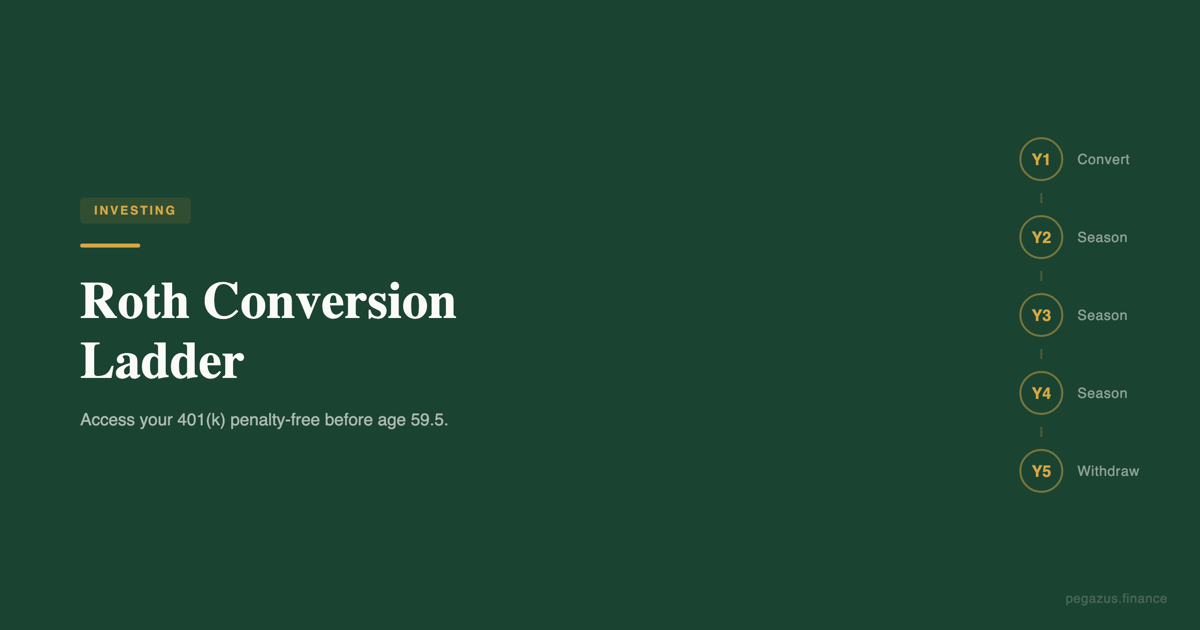
A Roth IRA conversion ladder lets early retirees access traditional retirement funds before age 59 and a half without the 10% penalty. You convert a portion of your traditional IRA or 401(k) to a Roth IRA each year, pay ordinary income tax on the conversion, then withdraw that converted amount tax-free after a five-year waiting period. The strategy works best when your post-retirement income drops you into the 10% or 12% federal tax bracket.
What is a Roth IRA conversion ladder and how does it work?
A Roth IRA conversion ladder is a multi-year strategy for accessing pre-tax retirement funds early. You roll money from a traditional IRA or 401(k) into a Roth IRA in annual increments, pay tax on each conversion at your current marginal rate, then withdraw the converted principal after five years have passed. Each year’s conversion starts its own five-year clock.
The IRS treats each conversion as a separate event under the ordering rules in Publication 590-B. Converted amounts come out before earnings. If you convert $40,000 in Year 1, that $40,000 becomes available for penalty-free withdrawal in Year 6. Meanwhile, your Year 2 conversion unlocks in Year 7, and so on. After five years of annual conversions, you have a steady stream of accessible funds every year.
The strategy is the backbone of most FIRE (Financial Independence, Retire Early) withdrawal plans because it bridges the gap between early retirement and age 59 and a half, when penalty-free traditional withdrawals begin.
How much tax do you actually pay on each conversion?
You pay ordinary income tax on the amount you convert, at whatever federal bracket that income falls into. The key insight is that early retirees often have little or no earned income, so conversions fill up the lower tax brackets first. When I last checked, the standard deduction for a single filer was roughly $15,000, meaning your first $15,000 in conversions would owe zero federal income tax.
| Conversion amount | Taxable after standard deduction | Approx. federal tax | Effective rate |
|---|---|---|---|
| $15,000 | $0 | $0 | 0% |
| $30,000 | $15,000 | $1,500 | 5.0% |
| $50,000 | $35,000 | $3,980 | 8.0% |
| $60,000 | $45,000 | $5,180 | 8.6% |
| $75,000 | $60,000 | $8,480 | 11.3% |
These figures use the 10% and 12% brackets from the IRS inflation adjustments. Married couples filing jointly get roughly double the standard deduction, so a couple with no other income could convert about $30,000 at 0% federal tax. State income tax varies. Nine states have no income tax at all, which makes the math even better if you relocate before converting.
What is the five-year rule and how do you track it?
Each Roth conversion starts its own five-year holding period. The clock begins on January 1 of the tax year you make the conversion. A conversion done any time during a calendar year counts as starting on January 1 of that year. If you convert in December of Year 1, the five-year period still runs from January 1 of Year 1 through December 31 of Year 5.
Withdrawing converted amounts before five years triggers a 10% early withdrawal penalty on the converted amount if you are under 59 and a half. This is why the ladder needs a bridge: you need five years of living expenses covered by other sources (taxable brokerage account, savings, or Roth contributions) while your first conversions season. The IRS Publication 590-B details the ordering rules that determine which dollars come out first.
What does a conversion ladder look like year by year?
Here is a simplified timeline for someone who retires at 40 with $800,000 in a traditional 401(k) and needs $40,000 per year in living expenses.
| Year | Age | Action | Living expenses funded by | Conversion seasoning |
|---|---|---|---|---|
| Year 1 | 40 | Convert $40,000 to Roth | Taxable brokerage account | Conversion 1 starts clock |
| Year 2 | 41 | Convert $40,000 to Roth | Taxable brokerage account | Conversion 2 starts clock |
| Year 3 | 42 | Convert $40,000 to Roth | Taxable brokerage account | Conversion 3 starts clock |
| Year 4 | 43 | Convert $40,000 to Roth | Taxable brokerage or Roth contributions | Conversion 4 starts clock |
| Year 5 | 44 | Convert $40,000 to Roth | Taxable brokerage or Roth contributions | Conversion 5 starts clock |
| Year 6 | 45 | Convert $40,000 to Roth | Withdraw Conversion 1 ($40,000) | Ladder is now self-sustaining |
From Year 6 onward, each new year unlocks a previous conversion. The ladder sustains itself as long as you keep converting. You need roughly five years of expenses in accessible accounts to bridge the gap. This is why most FIRE planners recommend building a taxable brokerage balance alongside retirement accounts.
What is the pro-rata rule and can it ruin your plan?
The pro-rata rule applies when you have both pre-tax and after-tax (nondeductible) money in traditional IRAs. The IRS treats all your traditional IRA balances as one pool when calculating the taxable portion of a conversion. You cannot selectively convert only the after-tax portion.
For example, if you have $90,000 in pre-tax traditional IRA money and $10,000 in nondeductible contributions, 90% of any conversion is taxable. The workaround is to roll all pre-tax IRA money into a current employer’s 401(k) before converting, which removes the pre-tax balance from the pro-rata calculation. The IRS uses Form 8606 to track nondeductible contributions. This rule trips up many early retirees who assume they can cherry-pick which dollars to convert.
Is the conversion ladder still worth it if tax rates rise?
The conversion ladder remains valuable even if future tax rates increase, because you are locking in today’s known rate rather than gambling on an unknown future rate. The current federal income tax brackets are set by the Tax Cuts and Jobs Act, which is scheduled to sunset. If the 12% bracket reverts to 15%, conversions done now at 10-12% will have been a better deal.
My real opinion: the conversion ladder is the single most powerful tool available to early retirees with pre-tax retirement accounts. It is not complicated once you understand the five-year clock. The only people who should skip it are those who expect their income in retirement to be higher than it is now, which is uncommon for early retirees living on a lean budget. Pair it with a Roth IRA funded during your working years, and you have two separate tax-free income streams.
Frequently Asked Questions
Can you do a Roth conversion if you still have earned income?
Yes. There is no income limit on Roth conversions. High earners who cannot contribute directly to a Roth IRA can still convert traditional IRA funds. The conversion amount simply adds to your taxable income for the year, so plan the amount carefully to avoid jumping into a higher bracket.
Does the five-year rule reset if you do a conversion every year?
Each conversion has its own independent five-year clock. A conversion in Year 1 and a conversion in Year 2 have separate clocks. Year 1’s conversion is available in Year 6. Year 2’s conversion is available in Year 7. They do not reset or interfere with each other.
What happens to the conversion ladder at age 59 and a half?
Once you turn 59 and a half, the five-year rule for conversions becomes irrelevant because you can withdraw any Roth IRA funds (contributions, conversions, or earnings) penalty-free as long as you have had any Roth IRA open for at least five years total.
Can you undo a Roth conversion if the market drops?
No. The IRS eliminated recharacterization of Roth conversions starting with tax year 2018 under the Tax Cuts and Jobs Act. Once you convert, you cannot reverse it. This makes timing and amount planning more important.
Sources
- IRS Publication 590-B, Distributions from Individual Retirement Arrangements — irs.gov
- IRS Tax Inflation Adjustments — irs.gov
- IRS Form 8606 Instructions, Nondeductible IRAs — irs.gov
- Tax Cuts and Jobs Act, Section 13611 (recharacterization repeal) — congress.gov
Date checked: September 2026
This article is for informational purposes only and does not constitute tax or financial advice. Consult a qualified tax professional before executing a conversion strategy. See our full disclaimer and research methodology.