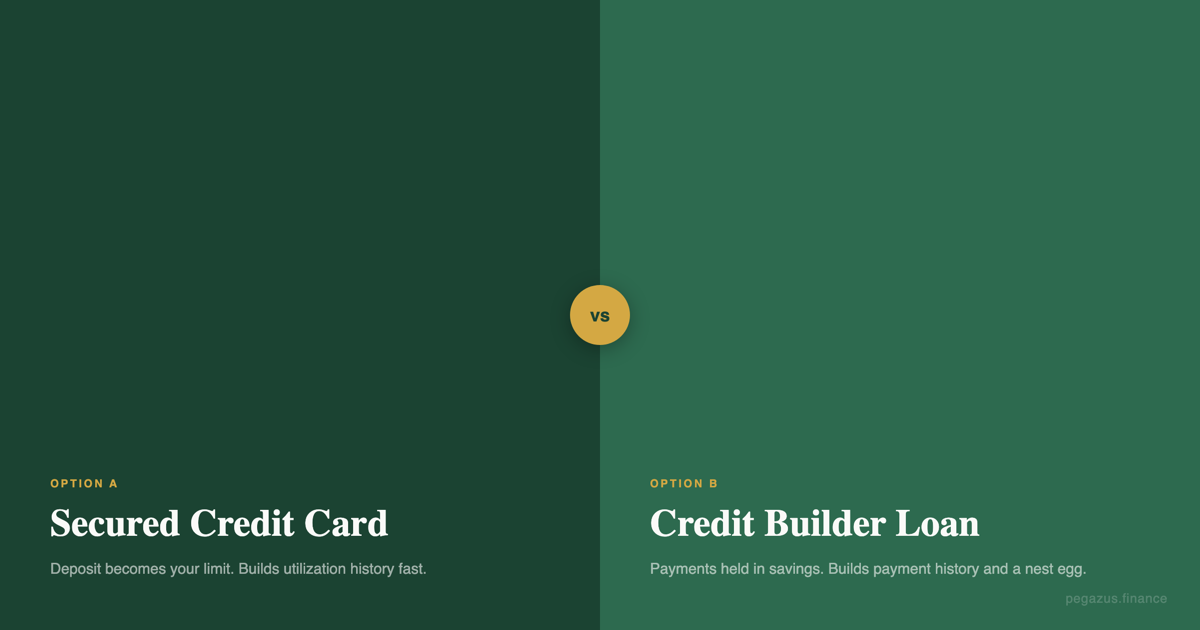
A secured credit card is the better choice for most people building credit from scratch because it reports a utilization ratio immediately and can graduate to an unsecured card within 12 months. A credit builder loan works better if you want forced savings built into the process. Both report to all three bureaus, both cost roughly the same over a year, and both can push a thin file past 650 within six to eight months of on-time payments.
What is a secured credit card and how does it build credit?
A secured credit card requires a refundable cash deposit that serves as your credit limit. If you deposit $200, your limit is $200. You use it like a regular credit card, make purchases, and pay the balance each month. The card issuer reports your payment history and utilization to Equifax, Experian, and TransUnion. The deposit protects the issuer if you default.
The credit-building advantage is immediate. The moment your first statement closes, the card reports a utilization ratio to the bureaus. Keeping that ratio below 30% (ideally under 10%) signals responsible usage. According to FICO’s scoring model, amounts owed account for 30% of your score. A secured card with a $500 limit and a $50 monthly balance shows 10% utilization from day one.
Most secured cards offer a path to graduation. The Discover it Secured Card reviews accounts after eight months and may return your deposit while converting to an unsecured card with a higher limit. Capital One Platinum Secured does the same, and some issuers increase your limit without requiring additional deposits after consistent on-time payments.
What is a credit builder loan and how is it different?
A credit builder loan flips the traditional lending model. Instead of receiving money upfront, you make fixed monthly payments into a locked savings account. Once you complete all payments, the lender releases the full amount to you. Throughout the repayment period, the lender reports your on-time payments to the credit bureaus.
Self Financial (formerly Self Lender) is the most widely used credit builder loan provider. Their plans start at $25 per month for 24 months, with a total loan amount of roughly $520 after interest. Self reports to all three bureaus. MoneyLion offers a similar product through their Credit Builder Plus membership. The interest you pay is the cost of building credit, and you get most of the principal back at the end.
The key difference from a secured card: a credit builder loan adds an installment account to your credit file, not a revolving account. FICO’s credit mix factor (10% of your score) rewards having both types. If you only have student loans, adding a revolving secured card helps more. If you only have a credit card, an installment credit builder loan diversifies your mix.
How do they compare side by side?
The decision depends on your starting point, your budget, and whether you value forced savings or spending flexibility more.
| Feature | Secured credit card | Credit builder loan |
|---|---|---|
| Upfront cost | $200-$500 refundable deposit | $0 upfront (pay monthly) |
| Monthly cost | $0 if paid in full | $25-$48 per month |
| Account type | Revolving credit | Installment loan |
| Credit utilization reported | Yes, immediately | No (no revolving balance) |
| Time to first score impact | 30-60 days | 30-60 days |
| Savings component | Deposit returned at graduation | Loan amount released at end |
| Graduation path | Upgrade to unsecured card | Loan ends, savings released |
| Annual fee | $0 (Discover, Capital One) to $39 | None (interest is the cost) |
| Best for | Daily spending + credit building | Forced savings + credit building |
Which popular products should you consider?
The secured card market and credit builder loan space have a few standout options that consistently rank well for people with no credit history or thin files.
| Product | Type | Min. deposit / payment | Annual fee | Key feature |
|---|---|---|---|---|
| Discover it Secured | Secured card | $200 deposit | $0 | 2% cash back at restaurants and gas, graduation review at 8 months |
| Capital One Platinum Secured | Secured card | $200 deposit | $0 | No foreign transaction fees, auto graduation review |
| Chime Secured Credit Builder | Secured card | No minimum deposit | $0 | No credit check to apply, uses checking account balance |
| Self Credit Builder | Credit builder loan | $25/month | N/A | Reports to all 3 bureaus, optional secured Visa card add-on |
| MoneyLion Credit Builder Plus | Credit builder loan | $19.99/month membership | N/A | Includes credit monitoring and financial tracking tools |
My recommendation: if you have $200 to put down today and want the fastest path to a usable credit score, choose the Discover it Secured. If you cannot afford a deposit right now but can commit to $25 a month, start with Self and add a secured card in three to four months once you have a thin score established.
Can you use both at the same time?
Yes, and combining them is actually the fastest strategy. Opening a secured card and a credit builder loan simultaneously gives you both a revolving account and an installment account on your credit report from the start. FICO rewards credit mix diversity, and having two active accounts reporting on-time payments builds your score faster than either product alone.
A study from the Consumer Financial Protection Bureau found that consumers who opened their first credit account and maintained six months of on-time payments saw median FICO scores above 650. Starting with two products doubles the positive payment history signals while costing roughly $225 per month (deposit plus credit builder payment). After six to eight months, most users in this dual approach cross the 670 threshold that unlocks unsecured credit cards and better loan terms.
How long does it take to see real results?
Both products begin reporting within 30 to 60 days of your first payment or statement close. FICO requires at least one account with six months of history to generate a score. VantageScore can generate a score with just one month of history. Most people starting from a completely blank credit file can expect a FICO score in the 630 to 680 range after six months of perfect payments on a secured card or credit builder loan.
The timeline to meaningful credit improvement depends on consistency. One late payment resets your momentum significantly. Payment history is 35% of your FICO score according to myFICO, making it the single most important factor. Set up autopay on both products and treat the payments as non-negotiable fixed expenses in your budget.
Frequently Asked Questions
Do secured cards and credit builder loans require a credit check?
Most secured cards run a soft or hard inquiry. Discover it Secured does a hard pull. Chime does not check credit at all. Self Financial runs a soft inquiry that does not affect your score. Always confirm the inquiry type before applying.
What happens to my deposit if I close a secured credit card?
Your deposit is returned in full after you pay any remaining balance and close the account. Most issuers mail a check or credit your bank account within one to two billing cycles. If you graduate to an unsecured card, the deposit is returned automatically.
Will a credit builder loan hurt my score at first?
Opening any new account may cause a small temporary dip from the hard inquiry (if applicable) and the reduction in average account age. This dip is usually 5 to 15 points and recovers within two to three months of on-time payments.
Sources
- FICO Score Factors — myfico.com
- Consumer Financial Protection Bureau, Credit Building Research — consumerfinance.gov
- Self Financial Credit Builder Loan — self.inc
- Discover it Secured Card Terms — discover.com
Date checked: September 2026
This article is for informational purposes only and does not constitute financial advice. See our full disclaimer and research methodology.